
1000 Guineas Runners and Riders: How to Profile the Field
 Available in US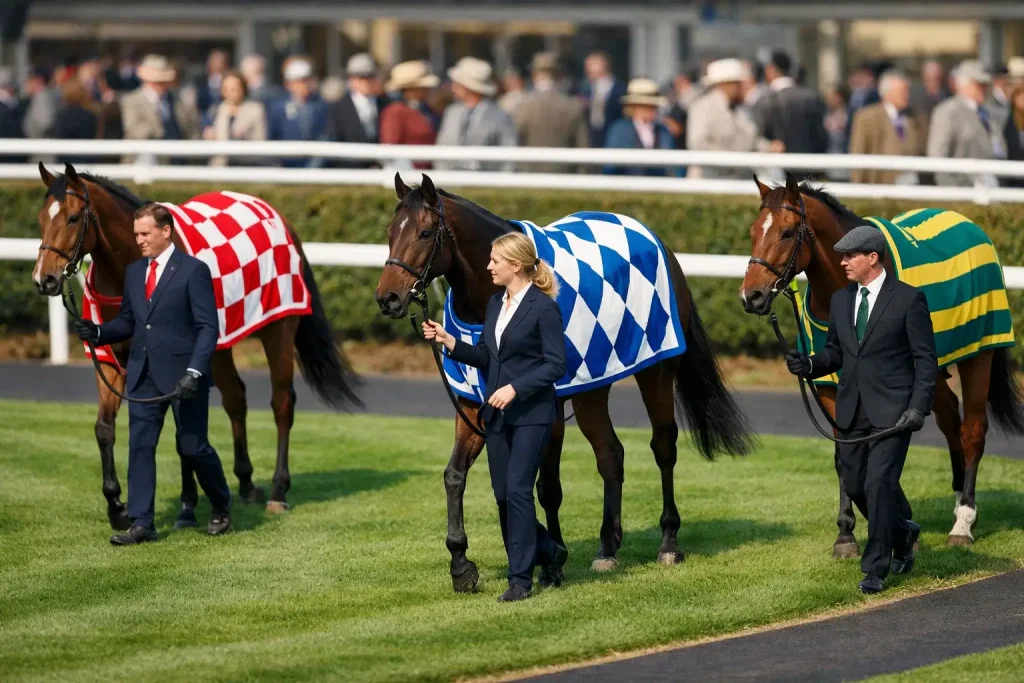
Reading the 1000 Guineas Field Before Declarations
Every year, weeks before the 1000 Guineas field is finalised, the betting market starts pricing up a provisional cast of runners. Names appear in ante-post lists, form analysts publish long-range assessments, and connections drop hints in morning interviews. Most of this is noise. The skill, for a bettor, lies in knowing how to profile the field systematically rather than reacting to each new piece of information as though it were decisive.
Profiling 1000 Guineas runners is not the same as tipping. It is not about identifying a winner. It is about building a framework that helps you assess each filly’s credentials against the specific demands of the race — the straight mile at Newmarket, the Dip, the uphill finish, the likelihood of a fast or slow pace. This framework stays relevant year after year, even as the names change. Whether the market favourite is a Ballydoyle raider or a Newmarket homebred, the questions you ask about her profile remain the same.
The 2026 running reinforced several of these principles simultaneously — and challenged a few. True Love won at 5/1 as O’Brien’s second string; Precise, the favourite with the best juvenile form in the field, finished seventh; and the placed fillies came from three different trainers at 16/1 and 33/1. A profiling framework that asked the right questions would have identified True Love as a live contender and flagged Precise as vulnerable. A framework that relied on headline form alone would have done the opposite.
Their preparation is judged in the trials.
What a Declarations Timeline Looks Like
The path from entry to the starting stalls involves several administrative stages, and each one carries betting implications. The initial entry stage occurs in late March or early April, when trainers pay a relatively modest fee to keep their fillies in the race. At this point, the list is long — often 30 or more entries — and includes speculative entrants as well as serious contenders. The ante-post market at entry stage is at its widest, and prices can be generous precisely because the field is still bloated with maybes.
The supplementary entry stage, available for fillies not originally entered, comes with a significantly higher fee. Supplementary entries are relatively rare in the 1000 Guineas, but when one appears, it tends to be a meaningful market mover. A trainer who pays a five-figure supplement is not doing so for a social run; the signal is that something has impressed in home work or a recent trial.
Five-day declarations, made the Tuesday before the race, cut the field down to its near-final shape. This is the point at which the market sharpens considerably. Non-runners after this stage are uncommon, though they do happen — morning-of withdrawals due to ground conditions or minor setbacks are an annual hazard. The final declarations, confirmed on the morning of the race, lock in jockey bookings and draw positions. Stall draws are allocated randomly by the BHA, and while draw bias on the straight Rowley Mile is minimal compared to turning tracks, certain positions can matter in specific ground conditions.
The 2026 declarations timeline illustrates how this process shapes the market:
| Stage | Date | Field Size | Key Movements |
|---|---|---|---|
| Initial entries | Late March | 34 entries | Precise installed as 7/4 favourite; True Love 12/1 |
| Supplementary stage | Mid-April | No supplements | Azleet shortened from 25/1 to 16/1 after Nell Gwyn win |
| Five-day declarations | Tuesday before race | 16 declared | Precise drifted to 5/2; True Love shortened to 6/1 |
| Final declarations | Race morning | 14 runners | Precise cut to 9/5 (market held); True Love backed into 5/1; Venetian Lace friendless at 40/1, drifted to 33/1 SP |
For bettors, the key takeaway is that the market you see in March is a fundamentally different market from the one you see on the Thursday before the race. Prices compress, information crystallises, and the field narrows. Knowing where you are in the declarations timeline helps you decide whether you are getting ante-post value or simply taking unnecessary risk. In 2026, the five-day declarations stage was the inflection point: True Love’s price contracted from 12/1 to 6/1 as professional money arrived, while Precise’s preparation setback became known to close followers but was never fully reflected in her price. The market was slow to adjust, and that lag was where the value lived.
Key Profiling Criteria: Age, Form, and Connections
Every runner in the 1000 Guineas is a three-year-old filly. That is a given. What varies enormously is how much racing each filly has done, what level she has competed at, and how relevant her previous experience is to the specific test ahead. A robust profiling method examines several layers.
Course Experience
The first and most predictive criterion is course experience. Over the last 13 years, 10 of 13 winners had raced at Newmarket at least once before the 1000 Guineas, according to analysis from TheStatsDontLie. This is not a trivial detail. The Rowley Mile is unlike any other track in Britain — dead straight, exposed to crosswinds, with the topographical demands of the Dip and rising ground. Fillies who have navigated it before hold a tangible advantage over those encountering it for the first time, particularly when the going is testing.
The 2026 field bore this out. True Love had won the Cheveley Park Stakes over six furlongs at Newmarket as a two-year-old — she knew the ground, the Dip, and the visual environment. Precise had won the Fillies’ Mile over the same course and distance the previous October. Both passed this filter comfortably. Evolutionist, second at 16/1, had placed behind Precise in the Fillies’ Mile and also had Newmarket form. Venetian Lace, third at 33/1, had run in the Fillies’ Mile as well, finishing fifth. The first three home all had prior Newmarket experience. Azleet, who finished last at 50/1, had won the Nell Gwyn over seven furlongs at Newmarket — she passed the filter on paper, but her running style and the step up to a mile exposed her.
Trial Race Performance
The second filter is trial race performance. The data shows that six of the last eleven winners contested the Fillies’ Mile at Newmarket within their most recent three starts. The Nell Gwyn Stakes, also run at Newmarket, has produced four winners since 2006 from its latest-start graduates. Other trials — the Fred Darling at Newbury, the Marcel Boussac at ParisLongchamp, the Cheveley Park Stakes — contribute runners but with lower conversion rates.
The 2026 field split along these lines in revealing ways. The table below profiles the principal runners by their trial route:
| Filly | Trial Route | Trial Result | Guineas SP | Guineas Finish | Verdict |
|---|---|---|---|---|---|
| Precise | Fillies’ Mile (Newmarket, Oct) | 1st | 9/5 | 7th | Best juvenile form, but interrupted spring prep |
| True Love | Cheveley Park (Newmarket, Sep) + Priory Belle (Leopardstown, Apr) | 1st / 1st | 5/1 | 1st | Unconventional route, but trial form confirmed |
| Evolutionist | Fillies’ Mile (Newmarket, Oct) | 3rd | 16/1 | 2nd | Strong Newmarket form; improved from winter |
| Venetian Lace | Fillies’ Mile (Newmarket, Oct) | 5th | 33/1 | 3rd | Modest trial form, but stayed on well |
| Azleet | Nell Gwyn (Newmarket, Apr) | 1st | 50/1 (drifted from 12/1) | Last | Trial winner, but failed to step up in trip |
| Abashiri | None (one juvenile start) | — | 8/1 | 5th | Lightly raced; no trial evidence |
True Love’s path through the Cheveley Park and the Priory Belle Stakes highlights a nuance that the standard data does not capture: not all recognised trials are British. The Priory Belle Stakes at Leopardstown, a Group 3 over seven furlongs, is not listed among the traditional Guineas feeders, but it produced the winner. For 2027, the profiling framework should widen to include Irish and French spring trials as legitimate — if not equally weighted — sources of Classic evidence.
Connections
The trainer-jockey-owner combination tells you something about intent and resource. Aidan O’Brien might enter four fillies, but his allocation of Ryan Moore to one of them is a signal that cuts through the noise. Godolphin’s decision to run one filly rather than two — or to supplement a late entry — carries meaning. The Haggas yard has historically targeted the race with a single carefully prepared runner rather than a scattergun approach. Knowing how each operation typically manages its Classic entries helps you distinguish between genuine contenders and entries made to keep options open.
In 2026, O’Brien’s internal hierarchy was the key to the race. Precise was the stable’s headline filly, with the best juvenile form and the Fillies’ Mile victory. True Love was the second string, ridden by Wayne Lordan rather than Ryan Moore. But the signals were there for those who looked: True Love’s victory in the Priory Belle Stakes at Leopardstown was a deliberate preparation, not an afterthought. O’Brien’s post-race comments confirmed that the Leopardstown run had given him the confidence to try her at a mile. The profiling lesson: within a multi-entry stable, the second string’s preparation can be as deliberate as the first string’s — and when the first string’s preparation is disrupted, the second string’s fitness edge becomes decisive.
The wider context is set out in our 1000 Guineas betting guide.
Breeding
Finally, breeding matters more in the 1000 Guineas than in most races, for a simple reason: these are lightly raced fillies, and pedigree is often the best available predictor of whether a horse will handle a mile on fast ground. Fillies by proven milers or Classic-producing sires carry a baseline expectation that their stamina and temperament will hold up under pressure. Those by pure sprinting sires may have the speed but face legitimate questions about whether they will see out the trip when the race gets serious in the final two furlongs.
The 2026 result challenged the conventional breeding wisdom. True Love is by No Nay Never — a sire known for speed, not stamina. By the standard breeding filter, she should have been vulnerable at a mile. But her dam was by Galileo, the greatest Classic sire of the modern era, and that stamina influence on the distaff side provided the genetic foundation for the step up in trip. O’Brien acknowledged the uncertainty in his post-race comments: “You couldn’t be sure she was going to get a mile, she’s a Queen Mary winner and it’s very unusual for a Queen Mary winner to get a mile.” But get a mile she did, powering through the Dip with stamina to spare.
The profiling implication for 2027: do not disqualify a filly on sire profile alone. The distaff side — the dam and her sire — can carry as much stamina information as the sire line. A filly by a sprinting sire but out of a staying mare is a different proposition from a filly by the same sire out of a sprinting mare. The 2026 winner proved that the nuance matters.
Stable Strength: Operations That Dominate the 1000 Guineas
The 1000 Guineas is not a level playing field in terms of resources, and pretending otherwise is a waste of a bettor’s time. A handful of operations dominate the race’s recent history, and understanding their strengths and patterns is part of any serious profiling exercise.
Ballydoyle
Aidan O’Brien’s Ballydoyle operation has now won the 1000 Guineas eight times — including True Love in 2026 — more than any active trainer, and within one of Robert Robson’s all-time record of nine. His approach is distinctive: he enters multiple fillies, uses the trials season to identify which is his number-one hope, and often runs the others as pacemakers or to ensure a tactical scenario that suits the stable star. Watching which filly gets Moore — and how the others are ridden in their trials — gives you a read on internal hierarchy that is worth more than most public tipsters’ assessments.
The 2026 race exposed a subtlety in this approach. When Precise’s preparation was disrupted by a temperature setback, O’Brien did not publicly downgrade her. The market kept her as favourite. But True Love’s preparation at Leopardstown was clean, and her fitness edge proved decisive on the day. The internal hierarchy that mattered was not the one announced in jockey bookings — it was the one revealed by preparation quality. For 2027, the profiling question for Ballydoyle runners is not just “who gets Moore?” but “whose spring preparation has been uninterrupted?”
Godolphin
Godolphin’s Newmarket-based operation, split primarily between the Charlie Appleby and Saeed bin Suroor yards, has the obvious advantage of training on the same gallops that adjoin the Rowley Mile. Their fillies often arrive at the 1000 Guineas with an intimate familiarity of the course, the ground, and the rhythm of Newmarket racing. Desert Flower’s 2025 victory — unbeaten in three starts — illustrated what happens when Godolphin’s machine locks onto a genuine Classic filly: the preparation was seamless, the market reflected the confidence, and the execution on the day was clinical.
In 2026, Godolphin was represented by Abashiri, a lightly raced filly with only one juvenile start. She finished a creditable fifth at 8/1, but the lack of foundational form was exposed. Godolphin’s pattern in the 1000 Guineas is clear: when they target the race with a well-prepared filly who has Group form, they are dangerous. When they send a filly who is stepping up in class and experience, they are vulnerable.
The Mid-Tier Yards
Beyond the big two, the mid-tier yards carry plenty of punch. The 2026 result was a showcase for this layer of the training ranks:
- Karl Burke trained Evolutionist, second at 16/1. Burke has established himself as a trainer capable of producing fillies competitive at the highest level. Evolutionist had placed behind Precise in the Fillies’ Mile and improved from that form on the day, confirming that Burke’s fillies train on through the winter.
- Charlie Johnston saddled Venetian Lace, third at 33/1. Johnston, son of the legendary Mark Johnston, is building his own Classic credentials. Venetian Lace had only finished fifth in the Fillies’ Mile, but her staying-on run in the Guineas suggested a filly who would improve for further distance — and she subsequently ran a respectable fourth in the Oaks at 20/1.
- William Haggas, John and Thady Gosden, and Ralph Beckett all remain capable of springing surprises with well-prepared contenders. These yards may lack the volume of entries that O’Brien and Godolphin deploy, but their strike rate with individual runners is competitive. A single-entry yard backing one filly with conviction can be a stronger market signal than a multi-entry operation hedging its bets across three.
The 2026 field profile, by trainer and result, is summarised below:
| Trainer | Filly | SP | Finish | Profile Strength |
|---|---|---|---|---|
| A. O’Brien | True Love | 5/1 | 1st | Strong: Group 1 form, course exp, fitness edge |
| K. Burke | Evolutionist | 16/1 | 2nd | Solid: placed in Fillies’ Mile, trained on |
| C. Johnston | Venetian Lace | 33/1 | 3rd | Modest: 5th in Fillies’ Mile, but staying type |
| A. O’Brien | Precise | 9/5 | 7th | Strong on paper, but disrupted prep |
| C. Appleby | Abashiri | 8/1 | 5th | Weak: one juvenile start, no trial evidence |
| K. Burke | Azleet | 50/1 | Last | Nell Gwyn winner, but failed at the trip |
The profiling takeaway is straightforward: know which stables are most likely to be represented, track their spring trial runners carefully, and pay attention to the signals — jockey bookings, public comments from trainers, and supplementary entries — that indicate where genuine confidence lies. But weight those signals by preparation quality, not just by stable reputation. The 2026 winner came from the dominant stable, but she was not the dominant stable’s first string on paper. She was the filly whose preparation had been cleanest.
