
Rowley Mile Course Guide: Newmarket’s Impact on 1000 Guineas Betting
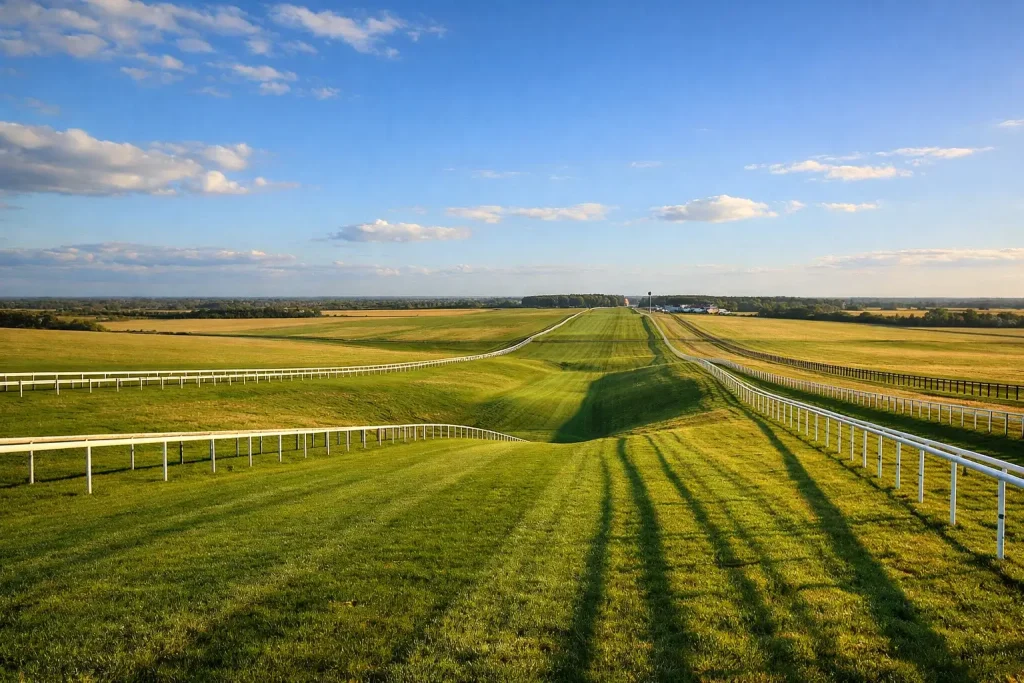
Why Newmarket’s Rowley Mile Is Unlike Any Other Course
Most British racecourses are defined by their bends — the camber at Epsom, the loop at Ascot, the tight turns at Chester. The Rowley Mile at Newmarket is defined by the absence of them. This is a straight course, wide and exposed, where there is nowhere to hide and no tactical shelter to be found. Every runner faces the same challenge: a long, honest test of speed, stamina, and the ability to handle undulations that are invisible to television viewers but brutally apparent to the horses themselves.
For 1000 Guineas bettors, the Rowley Mile is not just a backdrop. It is an active participant in the result. Understanding its layout, its quirks, and the way it interacts with ground conditions and rail positions is as important as reading the form book. A filly who has never raced on a straight course faces a fundamentally different challenge from one who has won on it before — and the betting market does not always price that distinction correctly.
Course Layout: 10 Furlongs Straight, The Dip, and the Rising Ground
The Rowley Mile’s straight course extends to 10 furlongs — approximately two kilometres — making it the longest straight track in Britain. The 1000 Guineas is run over one mile (eight furlongs) of this course, starting from chutes that feed into the main straight. The runners race from right to left as viewed from the stands, which means the finish line is at the western end and the start is further east along the heath.
The first four furlongs are deceptively flat but subtly undulating. The ground rises and dips gently, and on a day with any breeze — Newmarket sits on an exposed East Anglian heath — the wind can be a significant factor. Runners who go too fast early on soft ground, or who race into a headwind in the first half, can burn energy that they need in the closing stages. The 1000 Guineas, with its large fields and variable pace, is particularly susceptible to this: a contested early lead can set up the race for closers, while a dawdled pace rewards those with tactical speed.
The defining feature arrives at the two-furlong pole. The Dip is a pronounced depression in the track — a genuine downhill slope followed by an immediate uphill climb to the finish line. It is not a long feature, perhaps 100 metres from lowest point to the start of the rising ground, but its impact on the race is disproportionate. Horses descending into The Dip must maintain balance at speed while transitioning from flat running to a downhill gradient, and then immediately find the power to climb the final hill. Fillies who lose their action in The Dip — who become unbalanced, stumble slightly, or simply do not handle the change in gradient — can lose lengths that they never recover.
The final furlong is uphill. Not steeply — the gradient is gentle by any standard other than flat racing — but after a mile at racing pace, that incline sorts out the genuine stayers from those who got to the front on speed alone. A filly who leads entering The Dip but lacks the constitution to climb the rising ground will be swallowed up by closers. A filly with the stamina to sustain her effort through The Dip and up the hill is the one the race is designed to find.
This topography has a direct betting implication. Fillies whose form is built on front-running victories at flat tracks — Ascot’s straight course, for instance, which lacks The Dip — are vulnerable at Newmarket. Fillies who have won on the Rowley Mile before, or who have demonstrated the ability to pick up after a momentary loss of momentum, are better equipped. The form book does not always reveal this distinction; you have to know what to look for.
Rail Positions and Why Draw Data Can Mislead
One of the most common mistakes in 1000 Guineas analysis is treating historical draw statistics as reliable predictors. A typical pre-race preview might note that “low draws have a better record at Newmarket” and advise backing runners drawn in stalls one through five. The reality is considerably more complicated, and bettors who rely on simplistic draw data without understanding rail movements are building their analysis on a foundation that shifts with every meeting.
Newmarket’s groundstaff move the rail position — the inside running rail — between meetings and sometimes between days of the same meeting. The rail is repositioned to protect areas of the track that have been used heavily, ensuring fresh ground for subsequent races. This means that the effective racing strip can shift by several metres from one fixture to the next. A low draw might be advantageous when the rail is in its standard position, but neutral or disadvantageous when the rail has been moved to the stands’ side.
The 1000 Guineas is run on the Sunday of the Guineas Festival, which means the Rowley Mile has already hosted a full card on Saturday — including the 2000 Guineas. The ground on the Saturday racing line will have been used, and the rail may be adjusted to offer fresh ground on the Sunday. Bettors who check the rail position on the morning of the race, rather than relying on historical draw trends, are working with information that is both current and relevant. Those who are betting ante-post without knowing the rail position are making a decision on incomplete data.
The practical takeaway is that draw data in the 1000 Guineas is noise, not signal. Over a large enough sample, every stall position has produced winners, and the variation between “good” and “bad” draws is within the range that could be explained by the quality of the horses drawn there rather than the stall number itself. Rail movements make multi-year draw analysis unreliable. What matters is the specific rail position on the day, the prevailing wind direction, and whether the ground on the far side or the stands’ side is in better condition. None of these things can be known at ante-post stage.
Applying Course Knowledge to 1000 Guineas Selections
The Rowley Mile favours a specific type of runner. She needs to settle in the early stages without burning energy in a position battle. She needs to maintain balance through The Dip, which means she should be athletic and well-coordinated rather than long-striding and unwieldy. She needs the stamina to sustain her effort up the rising ground to the finish. And she needs the temperament to race without the tactical markers — bends, rail positions, a pace-setter to follow — that more conventional courses provide.
Previous Newmarket experience is the single most useful course-knowledge filter. Fillies who have won on the Rowley Mile, or who have placed in a Group race on the course, have already demonstrated that they can handle The Dip and the rising ground. Those who have only raced on galloping courses with bends — Ascot, York, Doncaster — may be perfectly capable, but the transition to a straight course is not automatic. A filly drawn from a small stable who won a novice race at Newmarket in the autumn may be better prepared for the Rowley Mile than a more expensively bred rival whose two runs have both been at Leopardstown.
Course knowledge also affects how you interpret pace. On a straight course with no bends, the jockeys’ positions at the two-furlong pole are roughly the positions they chose from the start. There is no reshuffling around a turn, no opportunity to switch off the rail. If a filly’s best form is in races where she was switched to challenge on the outside of a bend, she will not have that luxury here. The Rowley Mile rewards horses who can do their running without needing the course to create opportunities for them.