
Each-Way Betting on the 1000 Guineas: Finding Real Value
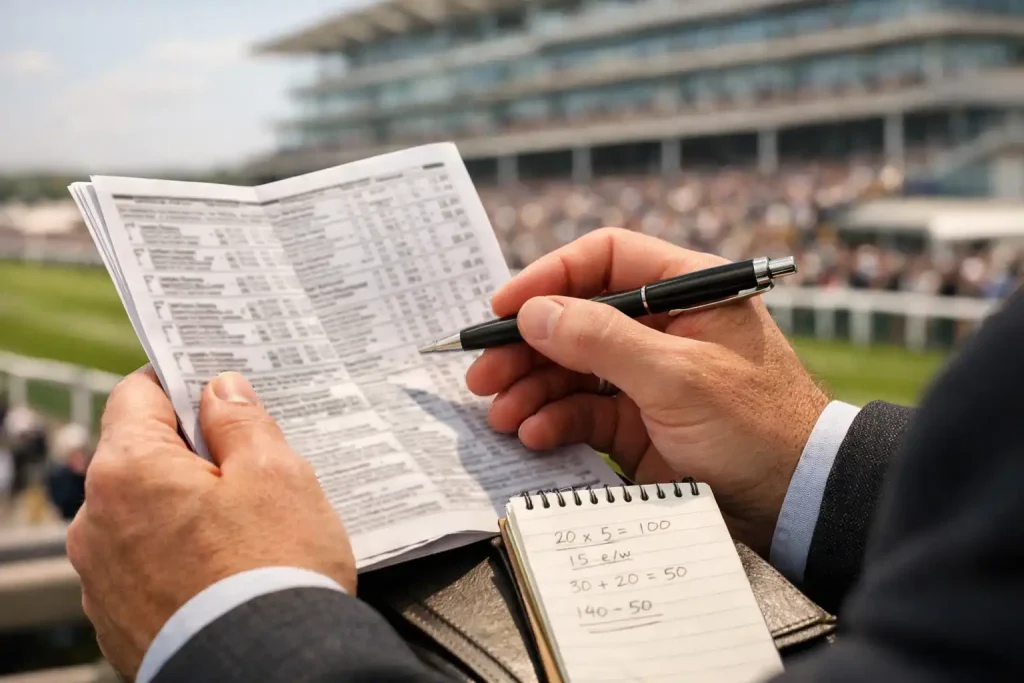
Why Each-Way Bets Suit the 1000 Guineas
The 1000 Guineas is a race that rewards each-way thinking. The field typically numbers between 10 and 16 runners, which means most bookmakers offer three or four places at a quarter or a fifth of the win odds. The favourite has a historically inconsistent record, which compresses the win market and pushes genuine contenders out to generous prices. And the nature of the race — a straight mile where pace, positioning, and the Rowley Mile’s topography can produce unexpected results — means that fillies finishing in the places are not flukes. They are runners who handled the test but just missed.
For bettors who understand how each-way mechanics interact with market structure, the 1000 Guineas offers some of the best each-way value on the flat racing calendar. This is not about blindly throwing darts at mid-priced runners. It is about identifying where the bookmaker’s margin creates a gap between the odds on offer and the true probability of a filly placing — and then exploiting that gap with disciplined selection.
How Each-Way Terms Work in a Classic
An each-way bet is two bets in one: a win bet and a place bet. Your total stake is doubled — a £10 each-way bet costs £20 — with half placed on the horse to win and half on the horse to finish in the places. The place part of the bet is paid out at a fraction of the win odds, determined by the each-way terms offered by the bookmaker.
For the 1000 Guineas, standard each-way terms are typically one-quarter of the win odds for the first three places when the field has eight to 15 runners. With 16 or more runners, some bookmakers extend to four places. A few offer enhanced each-way terms as part of their Guineas promotions — one-fifth of the odds for five places, for instance — though these invariably come with tighter win odds to compensate.
Here is the critical point that many casual bettors miss: the each-way fraction is derived from the win odds, but the win odds already include the bookmaker’s margin. According to data from OLBG, the average overround on the 1000 Guineas win market over the past 20 years has been 121%, with the tightest market recorded in 2026 at 115% and the loosest in 2023 at 130%. An overround of 121% means the bookmaker’s implied probabilities for all runners in the field sum to 121% rather than 100%, embedding a margin of roughly 21 percentage points. That margin is baked into both the win odds and, by extension, the place odds.
When you place an each-way bet, you are effectively betting into two separate markets, each carrying its own version of that margin. The place market margin is often higher than the win market margin because it is less transparent — bookmakers do not publish a separate place overround, and most bettors never calculate it. This is where the value analysis begins: if you can estimate a filly’s true probability of placing and compare it to the implied probability from the each-way terms, you can identify situations where the place part of the bet alone carries positive expected value.
Calculating True Each-Way Value
The mathematics of each-way value are not complicated, but they require you to think about the place component separately from the win component. Most bettors assess each-way bets by looking at the win odds and deciding whether the horse has “a chance.” That is the wrong starting point. The right starting point is the place probability.
Take a worked example. A filly is offered at 12/1 for the 1000 Guineas, with each-way terms of one-quarter the odds for three places. The win part pays 12/1. The place part pays 3/1 (12 divided by 4). Your £10 each-way bet costs £20 total: £10 on the win at 12/1 and £10 on the place at 3/1.
At 3/1, the implied probability of placing is 25% (1 divided by 4). So the question becomes: does this filly have a better than 25% chance of finishing in the first three? In a field of, say, 14 runners, a random horse would have a roughly 21% chance of placing (3 out of 14). But this is not a random horse — she has form, she has connections, she has a profile. If her true place probability is 30% or higher, the place part of the bet has positive expected value regardless of whether she wins.
This is where the favourite’s strike rate data becomes directly useful. Historically, 38.5% of 1000 Guineas have been won by the favourite. That means 61.5% of the time, the race has been won by something other than the market leader. In those years, the places are shared among runners across a wide price range. A filly at 12/1 in a year when the favourite disappoints has a materially better chance of placing than her raw odds suggest, because the favouritism that suppressed her price also suppressed the market’s assessment of her probability.
The calculation becomes even more favourable in years with large fields. When 16 runners go to post and bookmakers offer four places at one-quarter the odds, a 12/1 shot needs only a 25% chance of finishing in the first four. In a 16-runner field, random probability alone gives her 25% — so any form advantage at all tips the maths in your favour. This is why the 1000 Guineas, with its large fields and its tendency to produce upsets, is a textbook each-way race.
Best Each-Way Spots in the 1000 Guineas Market
Not every each-way bet is a good each-way bet. The value lies in a specific zone of the market, and stepping outside that zone in either direction erodes the edge.
At the top of the market — 2/1 and shorter — each-way bets are mathematically poor. A 2/1 shot paying 1/2 for a place offers minimal return on the place component relative to the stake, and the win odds are too compressed to deliver significant upside. You are paying for a double wager but getting single-bet value. At these prices, a straight win bet is almost always more efficient if you believe the filly will win, and a lay or pass is better if you are uncertain.
At the bottom of the market — 33/1 and beyond — each-way bets look tempting because the win payout is enormous, but the place odds (around 8/1 at one-quarter) overstate the horse’s chances. Fillies at these prices are typically there for a reason: their form is insufficient, their trial performance was uninspiring, or their connections are not giving strong signals. The odd 33/1 winner does appear — Billesdon Brook at 66/1 in 2018 remains the stuff of legend — but building a strategy around extreme longshots is a recipe for a long losing run punctuated by the occasional windfall.
The sweet spot for each-way value in the 1000 Guineas tends to sit between 8/1 and 20/1. Fillies in this range are typically serious contenders who have the form and the profile to place but are overshadowed in the market by one or two shorter-priced rivals. The place odds at these prices — between 2/1 and 5/1 — offer a genuine return, and the win odds provide meaningful upside if the favourite disappoints. When you combine this price range with a filly who ticks the profiling criteria — course form, relevant trial, strong connections — you have the ingredients of a disciplined each-way strategy.
One final practical point: shop around. The overround varies between bookmakers, and so do each-way terms. A filly offered at 14/1 with one bookmaker might be 12/1 with another; the difference in the place payout (3.5/1 versus 3/1) is material over a season of each-way betting. Best Odds Guaranteed offers, where the bookmaker pays out at the higher of the price you took and the starting price, add another layer of protection — though they rarely apply to ante-post bets. For on-the-day each-way punters, BOG is worth seeking out.