
Best Bookmakers for the 1000 Guineas: Comparing Margins, Features, and Offers
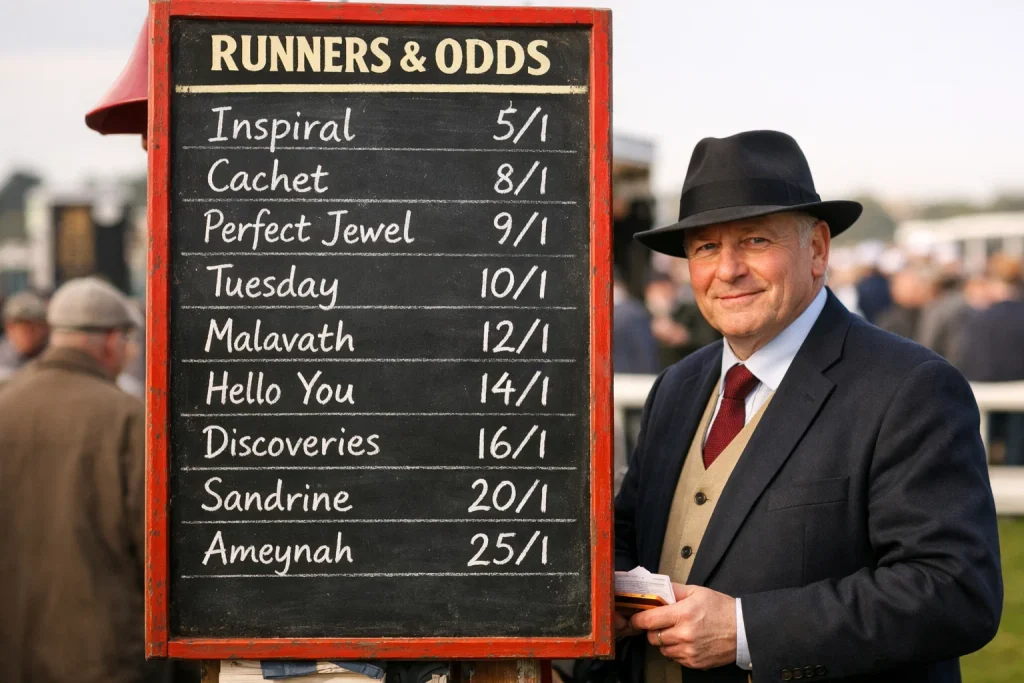
Not All 1000 Guineas Odds Are Created Equal
The price you get on a 1000 Guineas selection depends on where you place the bet. Two bookmakers can offer materially different odds on the same filly in the same race, and over a season of Classic betting, those differences compound into a significant edge or a significant cost. Choosing the right bookmaker for the 1000 Guineas is not about brand loyalty or the shiniest promotional banner — it is about understanding margins, features, and how different platforms price the race.
The UK betting market is competitive, regulated, and crowded. Dozens of licensed bookmakers offer odds on the 1000 Guineas, each with their own pricing strategy, each-way terms, and supplementary features. The bettor who shops intelligently across those platforms extracts more value from every wager than the one who defaults to a single account out of habit or convenience.
Overround Reality: What You Actually Pay on a 1000 Guineas Bet
The overround is the bookmaker’s built-in margin on a race. It is calculated by converting every runner’s odds into implied probabilities and summing them. In a perfectly fair market, those probabilities would add up to 100%. In practice, they always exceed 100%, and the excess is the bookmaker’s profit margin.
According to data from OLBG, the average overround on the 1000 Guineas win market across the past 20 years has been 121%. The tightest market was in 2026, at 115%, and the loosest was in 2023, at 130%. That range tells you something important: the margin you pay on a 1000 Guineas bet varies enormously from year to year and from bookmaker to bookmaker. In a 130% overround market, you are paying roughly 30p of every pound in margin. In a 115% market, the cost drops to 15p. The difference is material.
For practical purposes, a bettor should compare the overround offered by different bookmakers on the same race. The major firms — bet365, Betfair Sportsbook, William Hill, Paddy Power, Coral, Ladbrokes — will all price the 1000 Guineas, and their overrounds can differ by five or more percentage points. A bookmaker offering a 117% market is giving you better value than one offering 125%, because the prices on every runner are slightly more generous across the board. This is not a theoretical distinction. It is the difference between backing a filly at 10/1 and backing her at 9/1 for the same perceived chance of winning.
The overround also affects each-way bets, because the place portion is derived from the win odds. A tighter win overround produces better place odds, which means the each-way value in the 8/1 to 20/1 range — where the 1000 Guineas historically offers the best returns — is directly improved by choosing a lower-margin bookmaker.
Feature Checklist: BOG, NRNB, and Early Prices
Beyond the headline odds, bookmakers differentiate themselves through features that can add or subtract value from your 1000 Guineas bet.
Best Odds Guaranteed is the most important feature for day-of-race bettors. If you take a price in the morning and the starting price is higher, a BOG bookmaker pays out at the higher price. In the 1000 Guineas, where significant market moves can occur between the morning and the off, BOG provides free upside. Not all bookmakers offer BOG on all races, and some restrict it to bets placed within certain time windows. Check the terms before assuming coverage.
Non-Runner No Bet, as discussed in the ante-post context, is relevant for bettors placing wagers before race day. NRNB availability varies between bookmakers: some offer it from several weeks out, others only in the final days. The odds discount for NRNB also varies, so comparing NRNB prices across platforms is worth the effort. A filly at 12/1 NRNB with one firm might be 10/1 NRNB with another — a meaningful difference when the place portion of an each-way bet is calculated from those odds.
Early prices and ante-post availability also vary. Some bookmakers open their 1000 Guineas market in November; others wait until the spring trials. A bookmaker with an early, competitive ante-post market gives you the opportunity to lock in prices before the market moves, while one that opens late may offer tighter odds but less exposure to the ante-post risk. The context for this competition is a shrinking overall market: the BHA’s 2026 Racing Report showed that total betting turnover on British racing fell 4.3% year on year and 10.7% compared with 2023. Bookmakers are competing for a smaller pool of punters, and the features they offer — BOG, NRNB, enhanced each-way terms — are the mechanisms through which they attract and retain customers.
How to Read a Bookmaker’s 1000 Guineas Market
When you open a bookmaker’s 1000 Guineas market, you are looking at a structured representation of their view of the race — filtered through their margin. Reading that market intelligently requires three steps.
First, identify the market leader and her price. The favourite’s odds set the anchor for the entire market. If the favourite is 2/1, the market is saying she has roughly a 33% chance (before margin). If she is 5/2, that drops to around 28%. Compare the favourite’s price across bookmakers: if one firm has her at 2/1 and another at 5/2, the second firm is offering better value on the rest of the field as well, because their overall margin is likely tighter.
Second, check the each-way terms. For a 14-runner field, standard terms are one-quarter odds for three places. Some bookmakers offer enhanced terms — four places, or one-fifth odds for five places — but these usually come with adjusted win odds. Calculate whether the enhanced terms genuinely improve the expected value of your bet or whether the tighter win price offsets the benefit.
Third, look at the market shape. A steep market — where the favourite is 2/1 and the second favourite is 8/1 — suggests the bookmaker is confident in one runner and less certain about the rest. A flat market — where the favourite is 4/1 and several runners are bunched between 6/1 and 12/1 — suggests an open race with multiple genuine contenders. The 1000 Guineas historically tends toward the flat shape, which is why each-way betting is so productive in this race. If you see a steep market, question whether the bookmaker is over-pricing the favourite and whether the longer-priced runners represent genuine value or are simply making up the numbers.