
Watching the 1000 Guineas: TV Channel, Live Stream, and Coverage Guide
Where to Watch the 2026 1000 Guineas
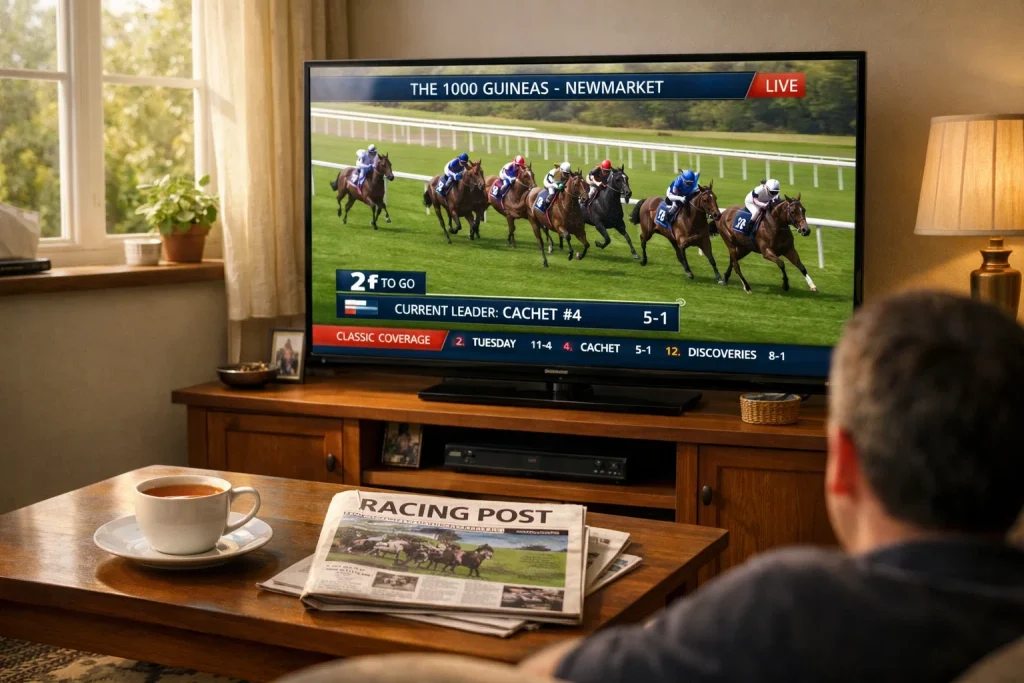
The 1000 Guineas is one of the most widely broadcast flat races in Britain, and the options for watching it in 2026 are broader than ever. Whether you are at home, on the move, or already at the racecourse, there is a way to watch the race live — and for bettors, the quality of your viewing setup can directly influence the quality of your decisions.
This is not just a viewing guide. How you watch the race, and what information you extract from the broadcast, feeds into your ability to assess in-running positions, monitor pace, and evaluate the ground conditions that the earlier races expose. The bettor who watches the full card with purpose has an advantage over the one who checks the result on a phone notification.
TV Coverage: ITV, Sky Sports Racing, and Racing TV
The 1000 Guineas is shown live on ITV, which holds the terrestrial broadcasting rights for British racing’s major meetings. ITV’s coverage of the Guineas Festival is part of their Saturday and Sunday afternoon racing programming, typically running from early afternoon through to the final race. The 1000 Guineas, as the Sunday headline, receives extensive build-up including paddock analysis, market movers, trainer interviews, and expert tips. For anyone in the UK with a Freeview television, this is the simplest and cheapest way to watch — free, in HD, with no subscription required.
Sky Sports Racing provides an alternative for subscribers, with coverage that tends to be more data-oriented and less personality-driven than ITV’s presentation. Sky’s racing channel offers extended pre-race analysis, going updates from the course, and post-race replays that ITV’s schedule does not always accommodate. For serious bettors, the additional depth of Sky’s coverage is worth the subscription cost, particularly on days where the going is changing or where the morning market moves are significant.
Racing TV is the dedicated racing channel owned by a consortium of British racecourses. It offers the most comprehensive coverage of any race meeting, with cameras positioned across the course and commentary that focuses on the racing rather than the entertainment angle. Racing TV’s Newmarket coverage benefits from its close relationship with the Jockey Club, which operates the course, and the production quality on Guineas day is among the best of the year. A Racing TV subscription also grants access to the full domestic fixture list, which is valuable for bettors who follow the form across the season. The audience for these broadcasts is substantial: the BHA’s 2026 Racing Report recorded that total UK racecourse attendance reached 5.031 million — the first time the figure had exceeded 5 million since 2019 — and the Guineas Festival is one of the meetings that drives both on-course attendance and peak TV audiences.
The commercial significance of these viewing figures is not lost on bookmakers. As HBLB Chief Executive Alan Delmonte noted in the Board’s 2026-25 Annual Report, the months covering major festivals saw bookmakers’ gross profits well above recent norms, with results at high-profile meetings generating particularly strong commercial outcomes. The Guineas Festival, alongside Cheltenham, the Derby, and Royal Ascot, sits in that tier of events where betting activity spikes and the television audience engages most intensely.
Live Streaming Options via Bookmakers
If you do not have access to ITV, Sky Sports Racing, or Racing TV, the next option is live streaming through a bookmaker account. Most major UK-licensed bookmakers offer live streaming of British racing to customers who hold a funded account or who have placed a bet on the meeting. The quality of these streams varies — from near-broadcast standard on the better platforms to grainy and delayed on others — but for a bettor whose primary interest is tracking the race in real time, they are functional.
The requirement to hold a funded account or have placed a bet to access the stream is not an accident. It is part of the commercial model that sustains live streaming as a feature. With online horse racing betting generating £766.7 million in gross gaming yield during 2026-25 according to the Gambling Commission, the investment that bookmakers make in streaming technology is a fraction of the revenue it helps generate. The stream keeps the bettor on the platform, engaged with the product, and available for in-play and next-race betting.
For the 1000 Guineas specifically, bookmaker streams are most useful if you are watching on a mobile device while at the course or while travelling. The ITV broadcast remains the superior option for picture quality and expert analysis, but the bookmaker stream provides a fallback that ensures you can watch the race live regardless of your location. Some bookmakers also overlay their streams with live odds, which allows you to track the in-play market alongside the visual. This is particularly useful in the final furlong, when the market is most volatile and the biggest in-running opportunities — and risks — arise.
How In-Race Viewing Helps Your Betting
The obvious reason to watch the 1000 Guineas live is to see the result. The less obvious — and more valuable — reason is to extract information that informs your future betting.
Watch the earlier races on the card for course intelligence. Which part of the track is the fastest ground? Are front-runners holding on, or are closers coming from behind? How is The Dip affecting runners — are they handling it comfortably, or are horses losing their action through the lowest point? This information, gathered from the supporting card, directly informs how you assess the 1000 Guineas field. If three races before the Classic all produce winners from a prominent position on the stands’ side, your 1000 Guineas selection should ideally have the draw and running style to exploit the same strip.
During the 1000 Guineas itself, watch for how the fillies travel through the race rather than focusing solely on who is in front. A filly who is travelling well on the bridle at the two-furlong pole, with her jockey sitting quietly while those around her are already pushing, is either going to win or finish in the places. Even if she does not win, that visual information feeds into the post-race market: a filly who ran an eye-catching race from a bad position may be undervalued in the ante-post Oaks or Coronation Stakes market, and the bettor who saw the race live, rather than reading a result line, has a genuine edge in assessing that post-race value.
The camera does not lie, even if the market sometimes does. Watching the 1000 Guineas with an analytical eye — tracking positions, ground preference, and running style — turns a passive viewing experience into an active data-gathering exercise. Over time, that data accumulates into the kind of pattern recognition that separates informed bettors from the rest.