1000 Guineas Free Bets and Offers: Which Ones Deliver Value
Free Bets Aren’t Free — But Some Are Useful
Every spring, as the 1000 Guineas approaches, bookmakers roll out their promotional artillery. Free bet offers, enhanced odds, money-back specials, and sign-up bonuses all compete for your attention and, ultimately, your deposits. The marketing language is designed to make it sound like the bookmaker is giving you something for nothing. They are not. Every promotional offer has a cost, whether it is visible in the wagering requirements, hidden in the adjusted odds, or embedded in the verification process that stands between you and your withdrawal.
That does not mean all offers are worthless. Some genuinely improve the expected value of a bet you were going to place anyway. Others are marketing exercises that look attractive in a banner ad but dissolve into nothing under scrutiny. The skill — and it is a skill — lies in distinguishing between the two. For 1000 Guineas bettors, understanding how to evaluate and deploy free bets within a specific race market is worth the effort.
Types of Offers: Matched Bets, Enhanced Odds, Refunds
Bookmaker promotions for major races like the 1000 Guineas tend to fall into a handful of categories, each with different mechanics and different levels of genuine value.
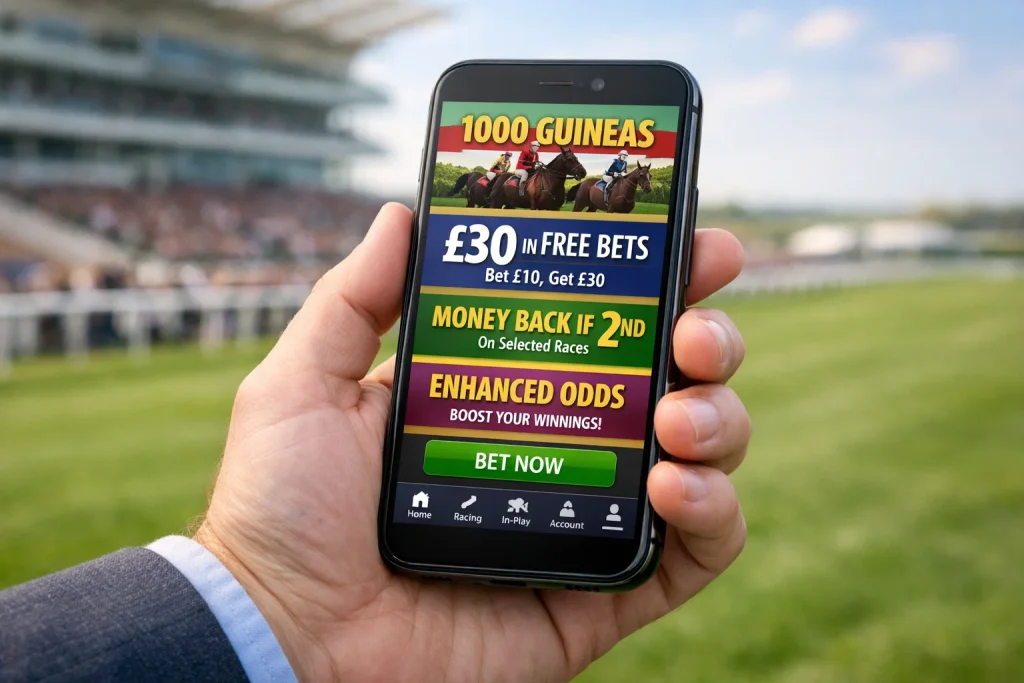
Sign-up free bets are the most common. A new customer deposits a qualifying amount, places a bet, and receives a free bet token — typically matching the qualifying stake up to a set limit, often £20 to £40. The free bet itself does not return the stake: if you place a £20 free bet at 5/1 and win, you receive £100 in winnings but not the £20 token. This stake-not-returned structure reduces the effective value of a free bet to roughly 70-80% of its face value, depending on the odds at which you use it. Using a free bet on a short-priced runner compounds this discount; using it on a longer-priced selection maximises the potential return relative to the zero outlay.
Enhanced odds offers are race-specific promotions where a bookmaker boosts the price on a particular runner. You might see the 1000 Guineas favourite offered at 6/1 rather than 2/1 to new customers, with winnings paid as free bets rather than cash. These offers look spectacular but are heavily capped — usually to a maximum stake of £1 or £5 — and the free bet payouts carry their own wagering conditions. The headline number is designed to attract attention, not to deliver material value. For a £5 maximum stake, the enhanced odds offer is a minor bonus, not a strategy.
Money-back specials, where the bookmaker refunds your stake as a free bet if your selection finishes second or third, are more interesting for the 1000 Guineas. In a race where the favourite has a historically unreliable record and placed finishers at decent prices are common, a money-back-if-placed offer effectively reduces your downside on a win bet. The refund is typically as a free bet, not cash, so the true recovery rate is again 70-80% of the stake. But in a race with volatile results, that partial safety net has genuine utility. The scale of the industry funding these promotions is significant — according to the Gambling Commission, online horse racing betting generated £766.7 million in gross gaming yield during 2026-25, and a portion of that margin flows directly into promotional spending.
Wagering Requirements and Hidden Terms
The gap between a promotional offer and actual money in your pocket is almost always filled by terms and conditions. Wagering requirements are the most common friction point. A free bet is not the same as cash; it must be “played through” — staked on qualifying bets — before any winnings can be withdrawn. Some bookmakers require the free bet to be used in a single wager, while others allow it to be split across multiple bets. A few impose minimum odds requirements, meaning you cannot simply dump the free bet onto a heavy favourite to guarantee a small return.
Time limits add another layer. Most free bet tokens expire within seven to 30 days. For 1000 Guineas-specific offers, the window may be even tighter — tied to the race day or the Guineas Festival weekend. If you claim a free bet on Thursday and the 1000 Guineas is on Sunday, you may have less time than you think to find the right spot to deploy it.
Then there is the regulatory dimension. Since the affordability checks regime was tightened in 2026, the process of claiming and withdrawing promotional funds has become more cumbersome. When Nick Timothy MP raised concerns in Parliament about the effects of what he described as disproportionate affordability checks on horse racing, he was speaking to a broader issue that directly affects promotional bettors. Enhanced verification requirements can delay withdrawals, and some bettors report having promotional winnings frozen pending document submissions. This does not make the offers themselves fraudulent — bookmakers are complying with the Gambling Commission’s regulatory framework — but it does mean that the practical value of a free bet is reduced if the withdrawal process adds friction that discourages you from following through.
How to Use Free Bets on the 1000 Guineas Market
The 1000 Guineas market has specific characteristics that influence how free bets should be deployed. The field is typically 10 to 16 runners, the favourite is unreliable at short prices, and the each-way market offers structural value in the 8/1 to 20/1 range. These features make the race well suited to free bet strategies that prioritise upside over certainty.
If you have a stake-not-returned free bet, the optimal approach is to use it on a selection at longer odds. Since the free bet stake is not returned regardless of the outcome, the marginal cost of backing a 14/1 shot versus a 2/1 shot with the token is zero — but the potential return is dramatically higher. A £20 free bet on a 14/1 winner pays £280; the same token on a 2/1 winner pays £40. In a race where longshots regularly outperform their odds, this is a natural fit.
For money-back offers, the calculus is different. Because your stake is returned as a free bet if the selection places, you can afford to back a slightly shorter-priced runner with your real money, knowing that the downside is partially protected. A filly at 6/1 who finishes second would normally cost you the full stake; with a money-back-if-placed offer, you recover 70-80% via the free bet refund. This makes the effective odds on the win bet more attractive than they appear.
One consideration that cuts across all promotional strategies: according to research published by NEXT.io based on Racing Post survey data, 61% of respondents to the 2026 Big Punting Survey refused to provide the financial documentation required by affordability checks, and the share of bettors using unlicensed operators rose from 3.6% to 4.9% between 2023 and 2026. The practical implication for promotional bettors is that claiming and withdrawing free bet winnings may trigger verification requests, particularly if your cumulative deposits across bookmakers are approaching the £150 monthly threshold. Factor this into your planning: there is no point claiming a £20 free bet if the withdrawal process costs you more in time and frustration than the bet is worth.
Used intelligently — on the right race, at the right odds, with a clear understanding of the terms — free bets and promotional offers can add a few percentage points of value to your 1000 Guineas betting. They are not the foundation of a strategy. They are a supplement, and treating them as such keeps expectations where they belong.