
Beyond O’Brien: Which Trainers Win the 1000 Guineas and How to Use Stable Form
 Available in US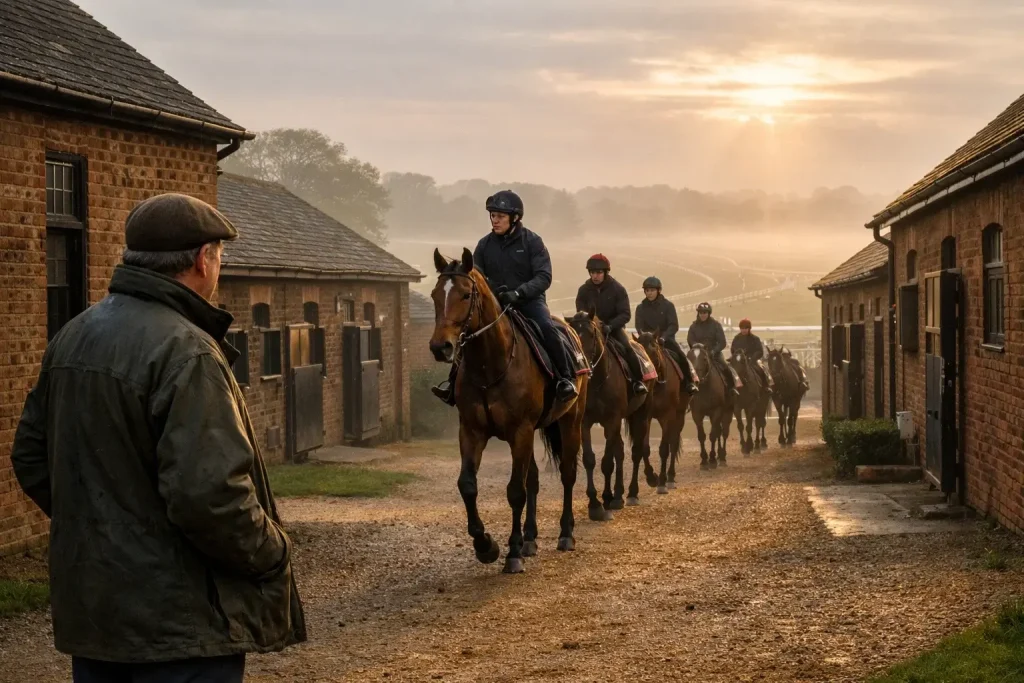
The Training Operation Behind Every 1000 Guineas Winner
Aidan O’Brien’s dominance of the 1000 Guineas is well documented, but the race is not a Ballydoyle benefit. Over the last two decades, trainers from across Britain and Ireland have won the fillies’ Classic, and some of those victories came from operations that the market barely acknowledged as serious contenders. Understanding which trainers — beyond O’Brien — have the record, the methodology, and the stable form to produce a 1000 Guineas winner is a genuine analytical edge, because the market tends to overweight the familiar names and underweight the emerging ones.
The trainer is not just a name on the racecard. The trainer is the strategist who decides when a filly is ready for the Classic, which trial she runs in, and how she is prepared physically and mentally for the demands of the Rowley Mile. Reading trainer form is reading intent, and intent is the variable that odds alone do not capture.
The dominant yard has its own record: Aidan O’Brien.
Trainer Record Table: Modern-Era 1000 Guineas
The modern-era 1000 Guineas has been won by a diverse group of trainers, even if O’Brien’s total dominates the aggregate. Charlie Appleby broke through with Desert Flower in 2026, confirming Godolphin’s Newmarket-based operation as a genuine Classic force distinct from the Suroor-era successes that preceded it. After that victory, Appleby described Desert Flower as the best filly he had trained — a statement of confidence that reflected both the quality of the horse and the maturation of his Classic programme. John and Thady Gosden have won the race, William Haggas has produced placed runners from his Newmarket base, and Richard Hannon saddled the remarkable 66/1 winner Billesdon Brook in 2018.
The breadth of the winning trainer list matters because it tells you that the 1000 Guineas is accessible to any operation with a high-class filly and a coherent plan. The total number of horses in training in Britain stood at 21,728 in 2026, according to the BHA’s Racing Report, a decline of 2.3% from the previous year. Within that shrinking population, the Classic-calibre fillies are concentrated in perhaps 20 to 30 yards. But the gap between the top three or four operations and the next tier is narrower than it was a decade ago. A filly trained by a Newmarket-based operation with Pattern-race experience is a viable 1000 Guineas contender regardless of whether the trainer’s name is O’Brien or not.
The common thread among winning trainers is patience and programme management. Classic preparation requires a trainer to resist the temptation to over-race a filly as a juvenile, to manage her development through the winter without exposing her to unnecessary risk, and to arrive at the Guineas with a horse who is physically and mentally ready for the most demanding one-mile race of her life. The trainers who win the 1000 Guineas more than once are those who have mastered this rhythm and can repeat it season after season with different horses, different temperaments, and different challenges.
Newmarket Yards vs Outsiders: Does Location Matter?
Newmarket is the headquarters of British flat racing, and its trainers have a structural advantage in the 1000 Guineas that is difficult to replicate from other locations. The Rowley Mile is their home course. Their fillies can gallop over the same straight mile they will race on, handle The Dip in training, and acclimatise to the course’s unique topography without the stress of a long journey on race day. According to TheStatsDontLie, nine of the last 12 1000 Guineas winners had at least one previous start at Newmarket, and a significant proportion of those were trained in the town.
This does not mean outsiders cannot win. O’Brien trains in Ireland and is the most successful trainer in the race’s modern history. But his runners routinely travel to Newmarket for autumn juveniles races, giving them the course experience that the data suggests is almost essential. An Irish- or Yorkshire-trained filly who arrives at the 1000 Guineas without having raced at Newmarket faces a steeper challenge: she must handle an unfamiliar course on the biggest day of her career, while her Newmarket-trained rivals are competing on ground they know intimately.
For bettors, the practical implication is a filtering criterion. A filly trained outside Newmarket who lacks Rowley Mile experience is a higher-risk proposition than her odds may imply. If she has shown the talent to overcome that disadvantage — and if her trainer has a track record of preparing runners for big-race performances away from home — the risk may be justified. But the default assumption should be that home advantage matters, and the data supports that assumption consistently.
The wider context is set out in our 1000 Guineas betting guide.
How Stable Form Signals 1000 Guineas Readiness
Stable form is the aggregate performance of a trainer’s string in the weeks leading up to the 1000 Guineas. It is not a single metric but a pattern: are the horses from this yard running to their marks? Are they winning their expected races? Are the jockey bookings consistent with a stable that is firing?
A trainer whose stable has been producing winners through March and April arrives at the Guineas with confidence and momentum. The horses are healthy, the training programme is working, and the connections are in a positive mindset. Conversely, a trainer whose stable has been underperforming — horses finishing below expectation, unexplained poor runs, jockey bookings that look uncertain — may be dealing with a virus, a training issue, or simply a string that is not at peak fitness. The 1000 Guineas is not the time to hope that a struggling yard suddenly produces its best performance.
Tracking stable form requires a few minutes of research on a racing database. Check the trainer’s recent runners, their finishing positions relative to their starting prices, and whether the pattern is improving or declining. If the stable is running hot in the two weeks before the Guineas, it is a positive signal for their Classic runner. If the stable is cold, it is a warning that the training programme may not have peaked in time. This is one of the simplest and most underused filters in Classic race analysis, and it costs nothing but attention. In a race where the margins between winning and losing are measured in necks and heads, the small edge that stable-form analysis provides can be the difference between backing a filly at her best and backing one who is not quite there on the day.
