
Coronation Stakes: The Royal Ascot Chapter After the 1000 Guineas
 Available in US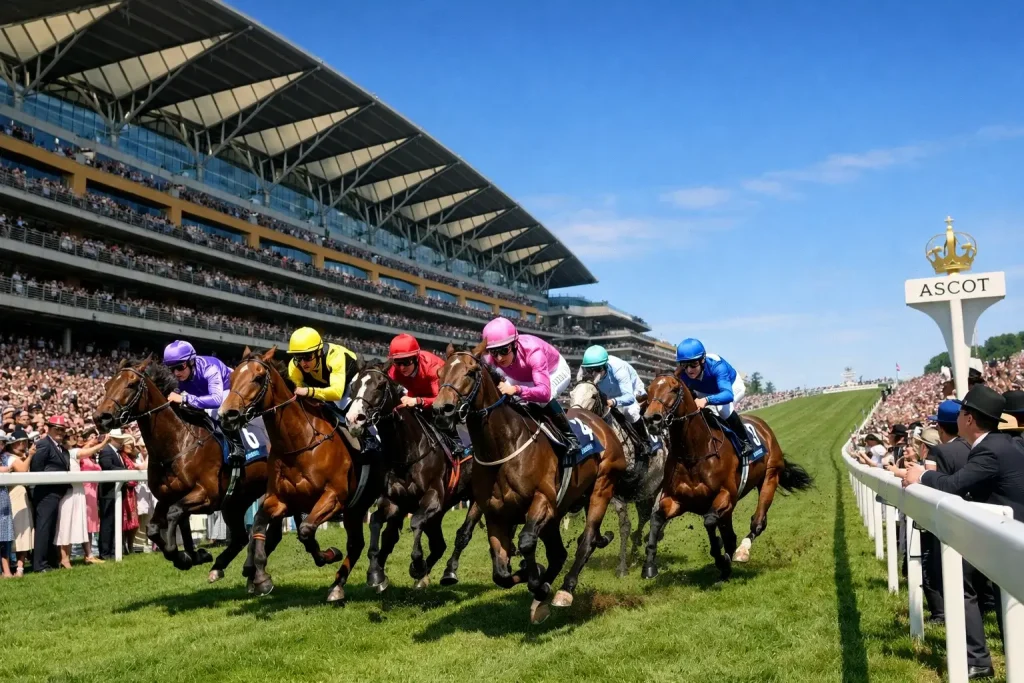
Why the Coronation Stakes Is the 1000 Guineas Rematch
The Coronation Stakes at Royal Ascot, run over one mile on the final Friday of the meeting in June, is the natural continuation of the 1000 Guineas story. The best miling fillies from Newmarket — the winner, the placed runners, and sometimes the disappointed favourite — reconvene at Ascot seven weeks later for a race that often settles the question of who is the best three-year-old filly over a mile. For bettors, the Coronation Stakes is where the 1000 Guineas form is either confirmed or overturned, and the ante-post market between the two races is one of the most dynamic pricing windows on the flat calendar.
The connection between the races is so strong that the Coronation Stakes ante-post market begins to take shape the moment the 1000 Guineas result is confirmed. Understanding how that market forms, and where the value lies, requires a grasp of how the two courses compare and how Classic fillies typically progress through the season.
The 2026 season produced one of the most compelling Coronation Stakes in recent memory. True Love, the 1000 Guineas winner at 5/1, bypassed the Oaks and targeted Royal Ascot as her next objective — a decision that made perfect sense given her speed-oriented pedigree by No Nay Never. But the rematch was not a formality. Precise, the Guineas favourite who had finished seventh at Newmarket after an interrupted preparation, had since redeemed herself with a commanding win in the Irish 1000 Guineas at the Curragh. She arrived at Ascot back to her best and seeking revenge. The Coronation Stakes became the race that would decide the pecking order of the miling fillies’ generation — and the result overturned the Newmarket hierarchy entirely.
The other post-Classic route is the Oaks.
Guineas Runners at Royal Ascot: Historical Strike Rate
The Coronation Stakes has been won by a 1000 Guineas runner more often than not in the modern era. The winner of the English fillies’ Classic is typically the market leader at Ascot, and her record justifies the position: Guineas winners who line up in the Coronation Stakes have a strike rate well above the field average, because they arrive as proven Group 1 performers with a level of form that the rest of the field has rarely matched.
The broader Classic picture provides context. According to data from How They Run, 50 fillies have completed the 1000 Guineas and Oaks double across the race’s history, and a significant number of Guineas winners who did not stay the Oaks trip instead targeted the Coronation Stakes as their second major objective. The Coronation has effectively become the miler’s alternative to Epsom — the race where speed-oriented Guineas fillies can confirm their superiority without the risk of being found out over a mile and a half.
The dominance of the Guineas form does not mean the race is a foregone conclusion. After the 2026 1000 Guineas, trainer Ollie Sangster observed that his runners had entered the race believing Desert Flower was virtually unbeatable, yet they pushed her close enough to demonstrate the narrow margins at the highest level. That dynamic carried forward to the Coronation in vivid fashion: a filly who was beaten at Newmarket came through the ranks to turn the form around. The seven-week gap between the two races allows for improvement, regression, and shifts in going preference that can overturn the Newmarket hierarchy entirely.
The 2026 Coronation Stakes result is the most recent proof:
| Position | Filly | SP | Previous Form | Trainer |
|---|---|---|---|---|
| 1st | Precise | 5/2 | 7th in 1000 Guineas; 1st in Irish 1000 Guineas | A. O’Brien |
| 2nd | True Love | 9/4 (fav) | 1st in 1000 Guineas | A. O’Brien |
| 3rd | Inspiral’s Legacy | 10/1 | Did not contest Guineas; won Listed trial at Newbury | J. & T. Gosden |
| 4th | French Dahlia | 12/1 | 3rd in Poule d’Essai des Pouliches (French 1000 Guineas) | F. Head |
How Ascot’s Straight Mile Compares to the Rowley Mile
Both the 1000 Guineas and the Coronation Stakes are run over a mile, but the courses are significantly different. The Rowley Mile at Newmarket is a straight ten furlongs with The Dip and a rising finish. Ascot’s round mile starts on a chute, turns right-handed into the home straight, and finishes with a stiff uphill climb to the winning post. The two tracks test different qualities, and not every filly who excels on one will handle the other.
The 2026 Coronation Stakes was a perfect illustration of this difference. True Love, who had won the Guineas with a prominent, front-running ride on Newmarket’s straight mile, was unable to replicate the performance on Ascot’s round course. The right-handed turn and the sustained uphill finish demanded a different kind of stamina — the kind that a filly by No Nay Never, however game, was always going to struggle to deliver. True Love led into the straight but was caught inside the final furlong by Precise, whose Galileo-influenced pedigree and tidier running style were better suited to the Ascot demands. The margin was three-quarters of a length — close enough to confirm True Love’s class, but decisive enough to reverse the Newmarket form.
The Ascot climb is more sustained than the Rowley Mile rise. A filly who was strong through the final furlong at Newmarket may find the Ascot hill an even greater test, particularly on soft ground where the gradient saps stamina. Conversely, a filly who was caught in The Dip at Newmarket — perhaps because the straight course exposed her to a pace she could not sustain — may benefit from the Ascot turn, which allows her jockey to settle her behind the field before producing her in the straight. The tactical options at Ascot are broader than at Newmarket, and fillies with a turn of foot rather than sustained pace tend to find the round course more accommodating.
Precise’s Coronation victory demonstrated this principle. At Newmarket, she had raced on the straight mile without cover and faded in the final two furlongs, undone by a combination of fitness deficit and the exposed nature of the Rowley Mile. At Ascot, Ryan Moore was able to settle her in behind True Love on the turn, conserve energy through the middle of the race, and produce her with a sustained run up the hill. The tactical freedom that the round course afforded was the difference between seventh place at Newmarket and victory at Ascot.
The ground is another variable. Newmarket in early May 2026 rode on good to firm ground, which suited True Love’s front-running speed. Royal Ascot in mid-June 2026 saw good ground with a slight ease after overnight watering — conditions that levelled the playing field and gave the closers a chance. A filly whose 1000 Guineas performance was flattered by fast ground may find similar conditions at Ascot; one who was disadvantaged by the going at Newmarket may get her preferred surface seven weeks later. Tracking ground preferences for each filly in the post-Guineas window — and comparing those preferences to the Ascot forecast — gives you a layer of analysis that the headline form does not capture.
The wider context is set out in our 1000 Guineas betting guide.
Ante-Post Angles After the 1000 Guineas
The window for Coronation Stakes ante-post value opens immediately after the 1000 Guineas and begins to close once Royal Ascot’s five-day declarations are published. Within that window, three types of bet offer the most consistent value — and the 2026 season validated each one.
Angle 1: The Guineas Winner at a Price That Reflects Non-Attendance Risk
Not every 1000 Guineas winner goes to the Coronation — some are routed to the Oaks or the Irish Guineas instead. If the winner is available at 2/1 or 5/2 for the Coronation in the days after Newmarket, and there is genuine uncertainty about whether she will attend, the price contains an ante-post premium that compensates for the non-runner risk. If she is confirmed, the price will shorten. If she bypasses Ascot, your stake is lost under standard ante-post terms.
In 2026, True Love was priced at 3/1 for the Coronation in the immediate aftermath of the Guineas, with uncertainty about whether she would target Ascot or the Oaks. Once O’Brien confirmed the Coronation as her next target, her price compressed to 5/2 within 48 hours. Punters who backed her at 3/1 captured the ante-post premium — though the race itself would ultimately go against her.
Angle 2: The Beaten Guineas Runner Who Stays On
A filly who ran the fastest closing sectional at Newmarket but finished second or third is a textbook Coronation Stakes improver. She has proven her ability at the highest level, and the extra seven weeks between races gives her time to freshen up and potentially improve. If she is available at 6/1 or longer for the Coronation, the each-way value is genuine.
The 2026 angle was subtler. Precise had not stayed on at Newmarket — she had faded. But her Irish 1000 Guineas win three weeks later was the signal that she was back to her best. Punters who backed her for the Coronation after the Curragh result, when she was still available at 4/1, captured value that disappeared once the market fully adjusted. The lesson: the post-Guineas window is not a single moment. It extends through the Irish Guineas and the French Guineas, each of which provides fresh information that can reopen the Coronation market.
Angle 3: The Fresh Filly Who Bypassed the Guineas
Some trainers target the Coronation as their fillies’ first Group 1, avoiding the early-season pressure of the Guineas in favour of a later peak. These runners arrive at Ascot fresh, potentially unexposed, and at prices inflated by the market’s focus on the Newmarket form. If the fresh filly has strong trial form and a profile that suits the Ascot hill, she represents value that the Guineas-obsessed market may miss.
The 2026 third, Inspiral’s Legacy at 10/1, trained by John and Thady Gosden, was exactly this type of runner. She had not contested the 1000 Guineas, instead winning a Listed trial at Newbury in mid-May. She arrived at Ascot fresh, unexposed at Group 1 level, and ran a race that suggested she will be a force in the Sun Chariot Stakes and beyond. The market, focused on the True Love–Precise rematch, underpriced a filly whose profile suited the Ascot track and whose stable had a proven Coronation Stakes record.
What the 2026 Coronation Stakes Tells Us for 2027
The 2026 result reinforces three principles that should guide Coronation Stakes analysis in 2027 and beyond.
First, the Guineas form is a starting point, not a conclusion. True Love won the Guineas but lost the Coronation. Precise was beaten at Newmarket but won at Ascot. The seven-week gap and the course differences are sufficient to overturn the hierarchy. A filly who underperformed in the Guineas for identifiable reasons — an interrupted preparation, unsuitable ground, a tactical disadvantage on the straight mile — may reverse the form at Ascot if those factors are resolved.
Second, the Irish Guineas is a critical data point. Precise’s Irish 1000 Guineas win was the signal that recalibrated the Coronation market. In 2027, bettors should monitor the Curragh result as closely as the Newmarket result, particularly when an English Guineas runner crosses the Irish Sea for redemption. The Irish Guineas–Coronation Stakes route is a proven path, and the market often underweights it.
Third, the Ascot track demands a specific profile. Fillies with a turn of foot who can be held up and produced late are better suited to the round mile than front-runners who excel on the straight course. The 2026 result — Precise coming from behind to catch True Love up the hill — was a textbook expression of this principle. When profiling Coronation contenders, weight running style and course suitability alongside raw form.
