
1000 Guineas Going and Ground Conditions: How They Shape Results
 Available in US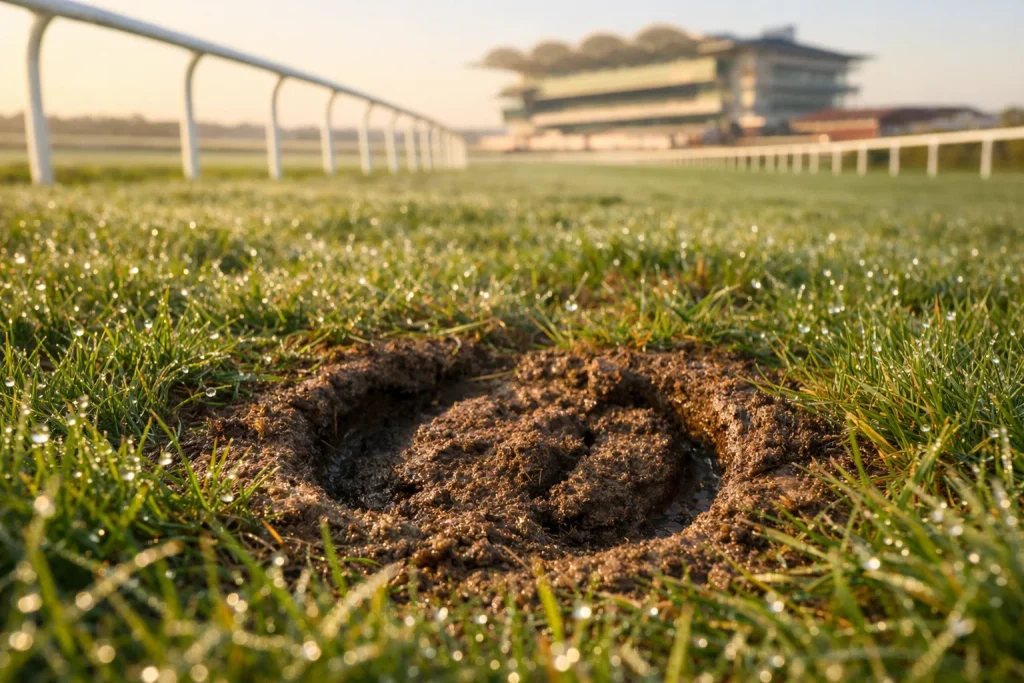
Going as the Hidden Variable in the 1000 Guineas
Every serious bettor studies form, checks the draw, and assesses the market. Fewer take the going seriously enough. In the 1000 Guineas, ground conditions are not a background detail — they are an active variable that can reshape the race, alter the pace, and turn a well-fancied filly into an also-ran. The Rowley Mile’s straight course amplifies the effect of the going because there is no shelter from the conditions: every runner is exposed to the same surface for the full mile, and those who do not handle it are punished without mercy.
Understanding how going categories work at Newmarket, how they correlate with winning times and race shape, and how to incorporate going forecasts into your selection process is a genuine edge in the 1000 Guineas. It is one of the few factors that the market consistently underprices, because most bettors treat it as a secondary consideration rather than a primary one.
Ground and draw interact: draw bias.
Going Categories and What They Mean at Newmarket
The official going in British racing is described on a scale that runs, from fastest to slowest: hard, firm, good to firm, good, good to soft, soft, and heavy. At Newmarket in early May, the going for the 1000 Guineas typically falls somewhere between good to firm and good, though it can shift in either direction depending on the spring weather. Hard ground is extremely rare at Newmarket — the Jockey Club’s watering programme prevents it — and heavy ground is unusual in May but not unknown after prolonged rain.
The distinction between good to firm and good is not trivial. On good to firm ground, the surface is quick and the ball bounces — speed horses are rewarded, and fillies with a low, daisy-cutting action tend to excel. On good ground, there is slightly more give underfoot, which allows horses with a round, higher action to find their rhythm. The difference might sound marginal, but over a straight mile it can separate winners from losers.
Winning times illustrate the point vividly. According to historical race data, the fastest 1000 Guineas was run in 1:34.22 by Ghanaati in 2009 on good to firm going — a blazing time that reflected both the speed of the filly and the pace of the surface. The slowest modern winning time belongs to Speciosa in 2006, who clocked 1:40.53 on ground that had eased significantly. Desert Flower, winning the 2026 renewal on good to firm ground, posted a time of 1:36.81 — a figure that places her comfortably toward the faster end of the spectrum without being exceptional. That range of more than six seconds between the fastest and slowest modern winners is enormous for a one-mile flat race and tells you just how much ground conditions influence the outcome.
How Going Affects Winning Times and Race Shape
The going does not just affect how fast the race is run. It changes the shape of the race itself — the tactical dynamics, the positioning, and the premium placed on different running styles.
On quick ground — good to firm or firmer — the pace tends to be honest from the start. Speed horses press forward because the surface rewards their action, and the field strings out earlier in the race. This is advantageous for front-runners and prominent racers who can dictate the tempo. Hold-up horses face a problem on fast ground: if the pace is strong and the field is well spread by the time they make their move, they may not have the tactical room to accelerate through gaps. The Dip, which arrives around a furlong and a half from the finish, is less of a leveller on fast ground because horses carry their speed through it rather than being checked by a heavy surface.
On softer ground — good to soft or soft — the race takes on a different character. The pace is slower, the field stays bunched for longer, and stamina becomes a more important factor than raw speed. Fillies with the action for soft ground — typically those with a higher knee action and a pedigree that suggests stamina — come into their own. The Dip becomes more significant on testing ground because it saps energy from horses who are already labouring, and the rising ground from The Dip to the winning post becomes a genuine stamina test rather than a formality.
The race shape on soft ground also favours hold-up runners. When the pace is slow and the field is tightly grouped, a filly ridden with patience can save energy in behind and produce a late burst when rivals are tiring. Several 1000 Guineas winners at longer prices have been delivered with this tactic on ground that blunted the pace and brought their stamina into play. The going does not just change the clock — it changes which type of horse wins.
For the bettor, the practical implication is straightforward: your selection needs to be matched to the conditions. A filly whose form is all on quick ground should not be blindly supported if the forecast suggests rain and easing going. Equally, a filly who has looked laboured on fast ground in her trial might improve significantly if the Guineas is run on a surface with more cut. Form on similar going is more predictive than form on different going, and ignoring this relationship is one of the most common errors in Classic race betting.
The wider context is set out in our 1000 Guineas betting guide.
Using Going Forecasts in Your Selection Process
The going is not fixed until the morning of the race, and it can change between the first race and the 1000 Guineas if weather moves through during the afternoon. This means the going forecast, rather than the declared going, is the variable you need to plan around — particularly if you are betting ante-post or early on the day.
Monitor the weather forecast for Newmarket from 48 hours before the race. The Met Office and specialist racing weather services provide hourly precipitation forecasts that are accurate enough to give you a reliable picture of how the ground will ride. If significant rain is expected, the going will ease from whatever has been declared on the morning inspection. If the forecast is dry and warm, the ground may ride faster than the official description, particularly in the afternoon sun.
Cross-reference the forecast with your shortlist. For each filly on your list, check her form on similar going. Has she won or run well on ground with comparable give? Does her action suggest she handles softer conditions? Is her pedigree one that points to an affinity for a particular surface — some sire lines, notably those descending from Sadler’s Wells, handle soft ground far better than those from pure speed lines like Danzig or Storm Cat. These are not guarantees, but they are probabilities that shift the odds in your favour.
The final check is the going stick reading, which Newmarket publishes on race morning. This numerical measure of ground firmness gives you a more precise picture than the verbal going description alone. A reading of 8.0 or above indicates quick ground; 7.0 to 7.9 is standard good; anything below 7.0 suggests significant ease. Combining the going stick with the weather forecast and your runners’ form preferences gives you a data-driven going assessment that most casual bettors never perform. In a race where six seconds separates the fastest and slowest modern winning times, that assessment can be the difference between backing the right filly and backing the wrong one.
