
1000 Guineas 2027: Date, Time, Runners, and Early Market Overview
 Available in US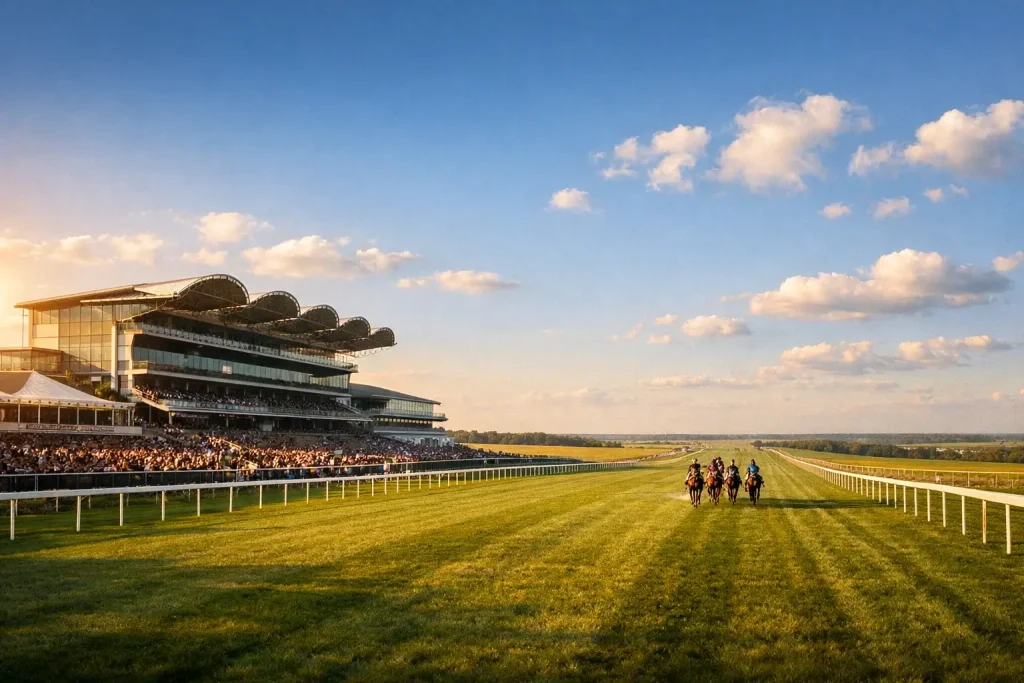
1000 Guineas 2027 at Newmarket Rowley Mile
The 2027 1000 Guineas is locked in. Sunday, 2 May, Newmarket’s Rowley Mile, 15:35 BST. That much is certain. What remains fluid — as it does every year — is which fillies will line up, how the ante-post market will shake out in the weeks ahead, and whether the early money proves shrewd or naive once the stalls open.
For anyone planning their Classic-season betting early, the 1000 Guineas sits in a peculiar sweet spot. It is the first fillies-only Classic of the British flat season, which means it draws from a shallow pool of proven form. Most contenders will have raced just two or three times. Trial results trickle in through March and April, reshaping a market that often bears little resemblance to where it started in January. The 2026 prize fund stood at a guaranteed £525,000, with the winner True Love collecting £297,727.50, and there is no indication Betfred’s sponsorship will trim the purse for 2027. The commercial incentive for connections to target this race — both in prize money and residual breeding value — keeps the field competitive and the market volatile.
This guide covers the confirmed logistics, the early ante-post picture, and how the 2027 Classic season calendar shapes the build-up. It is not a tips page. It is a framework for making sense of the information that will arrive between now and the first Sunday in May.
The rest of the card is covered in Guineas day races.
Date, Time, Venue, and Broadcast
The 1000 Guineas will be run on Sunday, 2 May 2027, as the feature race on day three of the Guineas Festival at Newmarket. The post time is 15:35 BST. It follows the 2000 Guineas, which takes place on the Saturday — a scheduling pattern that has been standard since the early 2000s, when the Jockey Club shifted both Classics to the same weekend to create a festival atmosphere. For 2027, the festival expands to three days, running from Friday 30 April through Sunday 2 May.
The venue is the Rowley Mile course at Newmarket, the same straight mile that has hosted this race since 1814. Unlike most British racecourses, the Rowley Mile is an entirely straight track, meaning there is no draw bias in the traditional sense — no bends to favour inside or outside positions. That said, the course does have its quirks, including a pronounced topographical dip roughly two furlongs from home followed by a stiff uphill finish. The terrain rewards stamina and balanced pace over raw speed, and it catches out horses who have never experienced it before.
Broadcast details for 2027 are yet to be formally confirmed, but ITV Racing has held the terrestrial rights to all five British Classics for several seasons and is expected to continue coverage. ITV’s main channel typically carries the race live, with extended build-up beginning after 13:00. For those outside the UK or without terrestrial access, Sky Sports Racing provides supplementary coverage, and most licensed bookmakers stream the race live to funded-account holders.
Tickets for the Guineas Festival go on sale through the Jockey Club’s official channels, usually from early in the new year. Enclosure options range from the Premier Enclosure — which includes access to the parade ring and winner’s enclosure — to more affordable general admission. Newmarket’s accessibility by road (the A14 corridor from Cambridge) and rail (Newmarket station is a short taxi ride from the course) makes it one of the easier Classics to attend in person.
What 2026 Taught Us: True Love, Precise, and the Ballydoyle Civil War
The 2026 1000 Guineas delivered a result that will shape ante-post thinking for years to come. Aidan O’Brien’s Precise, a dual Group 1 winner at two and the 9/5 favourite, could only finish seventh behind her stablemate True Love, who prevailed at 5/1 under Wayne Lordan. It was O’Brien’s eighth victory in the race, moving him within one of Robert Robson’s all-time record of nine.
The lesson was not that Precise lacked ability — she proved that emphatically by reversing the form in the Irish 1,000 Guineas at the Curragh three weeks later, beating True Love by two and a half lengths, and then confirming her superiority with a dominant success in the Coronation Stakes at Royal Ascot, where she justified 8/13 favouritism. The lesson was that an interrupted preparation can undo even the most talented filly on the day, and that Ballydoyle’s second string is never a token runner.
Beyond the O’Brien pair, the 2026 running produced a genuinely competitive 19-runner field. Evolutionist (Karl Burke) ran a fine race in second at 16/1, while Venetian Lace (Charlie Johnston) belied 33/1 odds to take third. The winner’s time of 1m 35.14s on good-to-firm ground was fast by 0.96 seconds, placing True Love toward the quicker end of recent winners. Venetian Lace subsequently took her chance in the Epsom Oaks, but was well beaten, highlighting the gap between mile and middle-distance form that defines the fillies’ Classic calendar.
The wider 2026 season also underscored O’Brien’s dominance across the fillies’ division. Diamond Necklace, his unbeaten daughter of St Mark’s Basilica, bypassed Newmarket entirely and instead won the French 1,000 Guineas at Longchamp before landing the Prix de Diane at Chantilly — a route that may tempt connections of similarly bred fillies in 2027. Meanwhile, the Oaks at Epsom went to Joseph O’Brien’s Thundering On, a Frankel filly who stormed from last to first to win by three and three-quarter lengths — a reminder that the fillies’ Classic narrative does not end at Newmarket.
Early Ante-Post Market and Key Contenders
At this stage of the season, the 2027 1000 Guineas ante-post market is more sketch than portrait. The major juvenile fillies’ races of autumn 2026 — the Cheveley Park Stakes on 26 September and the Fillies’ Mile in early October — have yet to be run, and both will reshape the picture dramatically. What we can identify now are the names already circulating at the head of the market.
Sun Goddess (Aidan O’Brien) — the current ante-post favourite at around 8/1 to 10/1. A daughter of Sioux Nation, she became the first Ballydoyle-based filly to win the Group 1 Phoenix Stakes at the Curragh in August, and followed up with a devastating display in the Goffs Harry’s Half Million at York. O’Brien has indicated she may step up to seven furlongs for the Moyglare Stud Stakes at the Curragh on her way to the Cheveley Park Stakes, and believes she will handle the extra distance. If she does, she will head into winter as the filly to beat.
Victorious (Aidan O’Brien) — another Ballydoyle filly who was as short as 9/1 for the Guineas after winning the Queen Mary Stakes at Royal Ascot. However, she suffered a setback after that run and O’Brien has indicated she may not race again in 2026. Her talent is not in doubt — O’Brien rated her “very special” — but whether she can return in time for a Classic campaign is an open question. Ante-post punters should be aware that fillies recovering from setbacks are high-risk investments at this stage.
Alpha (Aidan O’Brien) — a big, powerful filly who has been aimed specifically at the Moyglare Stud Stakes. She finished third in the Debutante Stakes on her most recent start, but O’Brien was adamant that run was a stepping stone, not a peak. If she wins or places prominently in the Moyglare, expect her price to shorten considerably.
Beyond Ballydoyle, the picture is inevitably less defined. The Cheveley Park Stakes and Fillies’ Mile in September and October will introduce or confirm the leading contenders from Godolphin, the Haggas and Gosden yards, and the progressive mid-rank trainers who occasionally produce a live outsider. Karl Burke, who saddled Evolutionist to finish second at 16/1 in 2026, is likely to have at least one filly worth monitoring, and Charlie Johnston’s yard demonstrated with Venetian Lace that they can get a filly peaking for the first Sunday in May.
For bettors, the ante-post market in September is a double-edged tool. Prices are at their most generous — you will never get a bigger price on a genuine contender than you will right now — but the risk of non-runners is real. Fillies at this stage of their careers are fragile athletes. Setbacks in training, disappointing trial runs, or strategic rerouting to the French Guineas or the Oaks can all turn a well-backed ante-post selection into dead money. Non-Runner No Bet markets mitigate some of that risk but typically offer shorter odds in return.
The wider context is set out in our 1000 Guineas betting guide.
How the 2027 Classic Season Calendar Fits Together
The 1000 Guineas does not exist in isolation. It is the second of five British Classics and the first act in a fillies-specific narrative that extends through the Oaks at Epsom in early June and, for a rare few, into the St Leger at Doncaster in September. Understanding where it sits in the calendar matters because it affects which fillies are targeted at the race and how trainers time their preparation.
The 2000 Guineas on Saturday, 1 May, acts as the weekend’s opening salvo and often influences late betting on the fillies’ race. The 2026 edition produced a commanding performance from Bow Echo, trained by George Boughey and ridden by Billy Loughnane, who became the youngest trainer to complete the 2000/1000 Guineas double (following Cachet’s win in 2022). Bow Echo’s authoritative victory over Gstaad and Distant Storm set a benchmark for what constituted a strong Rowley Mile performance that weekend, and similar cross-contamination of form analysis can be expected in 2027.
After the Guineas Festival, the Classic trail moves to York’s Dante meeting in mid-May, which serves primarily as an Oaks and Derby trial. The Musidora Stakes at York is the key stepping stone for fillies aiming at Epsom, and it is here that 1000 Guineas runners often reappear — or, in some cases, fail to frank their Newmarket form. By late May, attention shifts to the Oaks itself, and bettors who have followed the 1000 Guineas closely hold an informational edge in that market. The 2026 Oaks was won by Thundering On, who had not run in the Guineas, but several Guineas runners — including Venetian Lace — took their chance at Epsom and underperformed, a pattern that is more common than the market tends to price in.
Royal Ascot in mid-June then offers the Coronation Stakes, a Group 1 over a mile that has become the de facto rematch race for the best of the Guineas generation. The 2026 Coronation Stakes produced a definitive result: Precise, who had flopped in the English Guineas and then won the Irish equivalent, confirmed her superiority over True Love in a 1-2-3 that also featured Touleen splitting the O’Brien pair. It was O’Brien’s 100th Royal Ascot winner — a milestone that underlined the depth of his operation. Five of the last ten Coronation Stakes winners ran in the 1000 Guineas earlier that season. For bettors with a longer horizon, tracking how the Guineas field disperses across these subsequent targets is where the real post-race value lies.
The calendar, in short, turns the 1000 Guineas into both an end in itself and a starting gun. Bet the race on its own merits, but keep one eye on what comes next.
About & Disclaimer
This content is for informational purposes only and does not constitute financial or betting advice. Gambling involves risk, and you should never bet more than you can afford to lose.
Play Responsibly (18+)
If you feel you may have a gambling problem, please contact GamCare or call the National Gambling Helpline on 0808 8020 133. You must be 18 or over to gamble in the UK.
