
1000 Guineas Form Reading: A Step-by-Step Method for Building a Shortlist
 Available in US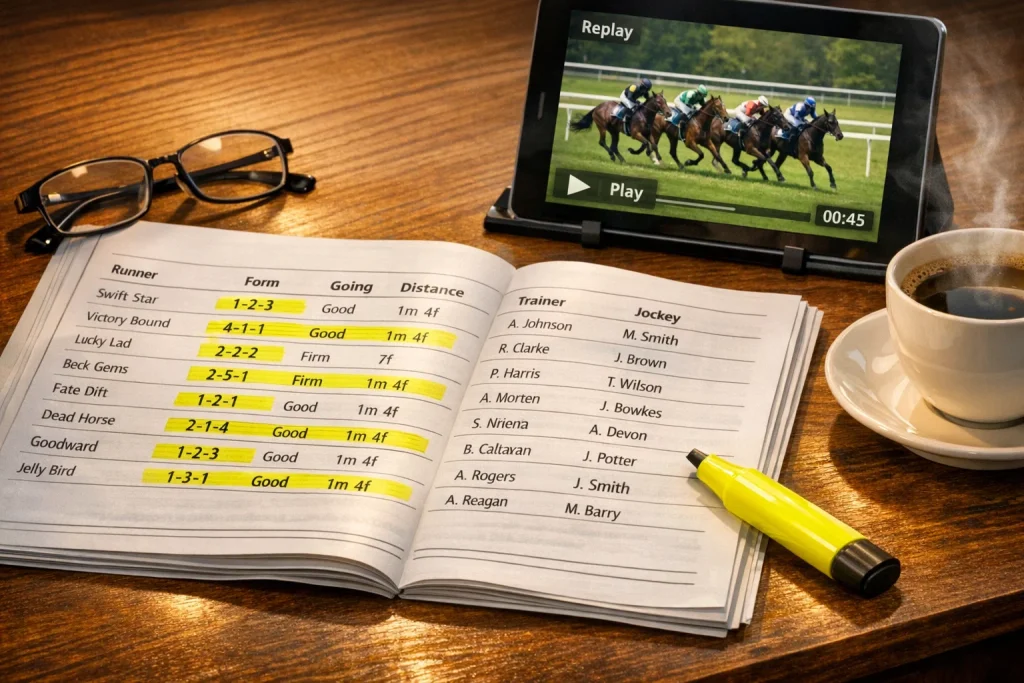
The System That Turns Race Data Into a Betting Shortlist
Form reading is the core skill of horse racing analysis. It is the process of examining a horse’s previous race performances — her finishing positions, the quality of the fields she competed in, the conditions she raced on, and the manner in which she ran — to estimate how she will perform in a future race. In the 1000 Guineas, where the field consists of lightly raced three-year-old fillies with thin form profiles, the challenge is sharper than in most races: the data is limited, the variables are many, and the market is priced on incomplete information.
This guide presents a three-step method for building a 1000 Guineas shortlist from the form book. It is not a prediction system. It is a filtering process that narrows the field from 14 or 16 runners to a shortlist of three or four who merit your money and attention.
The clock adds another layer: speed figures.
Step 1: Filter by Official Ratings and Pattern Form
The first filter is the bluntest and the most effective. Check each runner’s official BHA rating and her Pattern-race form. The 1000 Guineas is a Group 1 race, and it attracts fillies with ratings typically in the range of 100 to 115. A filly rated below 100 is competing above her proven level and needs significant improvement to be competitive. A filly rated above 110 is proven at or near the required standard. The rating does not tell you who will win, but it tells you who has the form credentials to contend.
Pattern form provides additional context. A filly who has won or placed in a Group 1 or Group 2 race as a juvenile has been tested at the top level and handled the pressure. A filly whose best form is in Listed company or maidens is stepping into uncharted territory. The historical record reinforces the importance of this filter: according to How They Run, the all-time favourite strike rate in the 1000 Guineas is 38.5%, and the favourites are almost always the highest-rated fillies in the field. But the 61.5% of renewals won by non-favourites were still won by fillies with strong ratings — just not the strongest. The race is not won by no-hopers; it is won by the second-, third-, or fourth-best filly on form who outperforms on the day.
Apply this filter ruthlessly. If a filly does not have the rating or the Pattern form to justify her inclusion, remove her from the shortlist. You should be left with six to eight runners after this step.
Step 2: Cross-Reference Course, Going, and Distance Form
The second filter introduces course-specific and condition-specific data. Not every filly with a high rating will handle the Rowley Mile, and the data is clear on this point: nine of the last 12 1000 Guineas winners had at least one previous start at Newmarket. Course experience on the Rowley Mile is the single strongest predictor of success in this race after raw ability, and a filly who lacks it faces a significant disadvantage regardless of her talent.
Check each remaining runner’s course form. Has she raced at Newmarket? If so, how did she handle The Dip and the rising ground? Did she race prominently or come from behind? The visual evidence from her Newmarket runs — available in race replays on most racing platforms — is more informative than the bare result. A filly who finished fourth at Newmarket but was travelling well through the race and only weakened in the final furlong may be a better prospect than one who won a lesser race at a different course.
Going form is the next layer. Cross-reference each runner’s form with the expected ground conditions for the 1000 Guineas. A filly with all her form on soft ground is a risk if the forecast is dry and the going is good to firm. A filly who has only raced on fast ground may struggle if rain eases the conditions. The going is a variable that the market does not always adequately price, because most bettors focus on form without adjusting for conditions. In an era when affordability checks and regulatory hurdles can complicate the betting process, the bettors who do their own analysis thoroughly — rather than relying on tips or gut feeling — have the most durable edge. As Nick Timothy MP observed when discussing the broader impact of gambling regulation, the emphasis should be on making informed decisions within the framework that exists, not on circumventing it.
After applying this filter, your shortlist should contain three to five runners who have the ratings, the course form, and the going profile to be genuine contenders.
The wider context is set out in our 1000 Guineas betting guide.
Step 3: Finalise with Market Position and Value Assessment
The final step is to compare your shortlist with the betting market. For each runner on your list, note her current odds and calculate the implied probability. Then ask: is my assessment of her chance higher than the market’s? If yes, she is a value bet. If no, she is correctly priced or overpriced, and backing her would not generate a positive expected return over time.
This is where the analytical work pays off. A filly who passes all three filters — strong rating, Newmarket course form, appropriate going profile — and is available at 10/1 or longer is a textbook value selection. The market is telling you she has roughly a 9% chance of winning (before margin), but your analysis suggests her true chance is higher. Each-way at these prices, in a race where the favourite fails more often than not, is the kind of bet that a systematic approach is designed to find.
Conversely, a filly who passes the filters but is priced at 5/2 may be the most likely winner, but the price leaves no room for error. If you believe she has a 35% chance of winning, and the market implies 28% (after adjusting for overround), the edge is slim. Whether that edge justifies a bet depends on your bankroll management and your appetite for thin margins. For most bettors, the value in the 1000 Guineas lies further down the market, where the form-based edge is largest relative to the price.
The shortlist method does not guarantee winners. Nothing does. But it gives you a structured, repeatable process for engaging with the 1000 Guineas that is grounded in data rather than narrative. Over multiple renewals, that process will outperform instinct, tips, and the kind of casual analysis that the market absorbs and neutralises every year.
