
1000 Guineas History: Records, Legends, and the Fillies’ Triple Crown
The Race That Has Defined Fillies’ Flat Racing Since 1814
The 1000 Guineas is older than the railway, older than photography, older than the very concept of a weekend as we understand it. First run in 1814, a year before Waterloo, this race has witnessed the entire arc of British flat racing’s evolution—from an aristocratic pastime to a multi-billion-pound industry, from private wagers between gentlemen to global betting markets accessible on a smartphone. Through two centuries and more, it has remained what it was always intended to be: the definitive test of the three-year-old filly over a mile.
Understanding the history behind Britain’s premier fillies’ Classic is not merely an exercise in nostalgia. The patterns that shaped past results continue to influence present markets. The trainers who dominate now follow paths blazed by predecessors whose names still resonate at Newmarket. The breeding lines that produce modern winners trace back through generations of champions whose victories are recorded in the same Rowley Mile winners’ enclosure.
This article traces the history of the 1000 Guineas from its origins through its greatest moments. It examines the seven fillies who achieved the almost impossible feat of the Fillies’ Triple Crown, the trainers who built dynasties around the race, and the record-breakers and long-shot winners who defy easy explanation. History does not predict the future, but it illuminates the terrain on which the future will be won.
Origins and Evolution: From Jockey Club Stakes to Modern Classic
The 1000 Guineas owes its existence to a simple problem of taxonomy. By 1814, the Derby and the Oaks had been established for over three decades, giving three-year-olds their definitive tests at Epsom. The 2000 Guineas, founded in 1809, had created a sprint-miler championship for colts at Newmarket. What remained missing was an equivalent for fillies—a race that would identify the best of her generation over a mile before the longer stamina tests of summer. The Jockey Club filled that gap, and the 1000 Guineas was born.
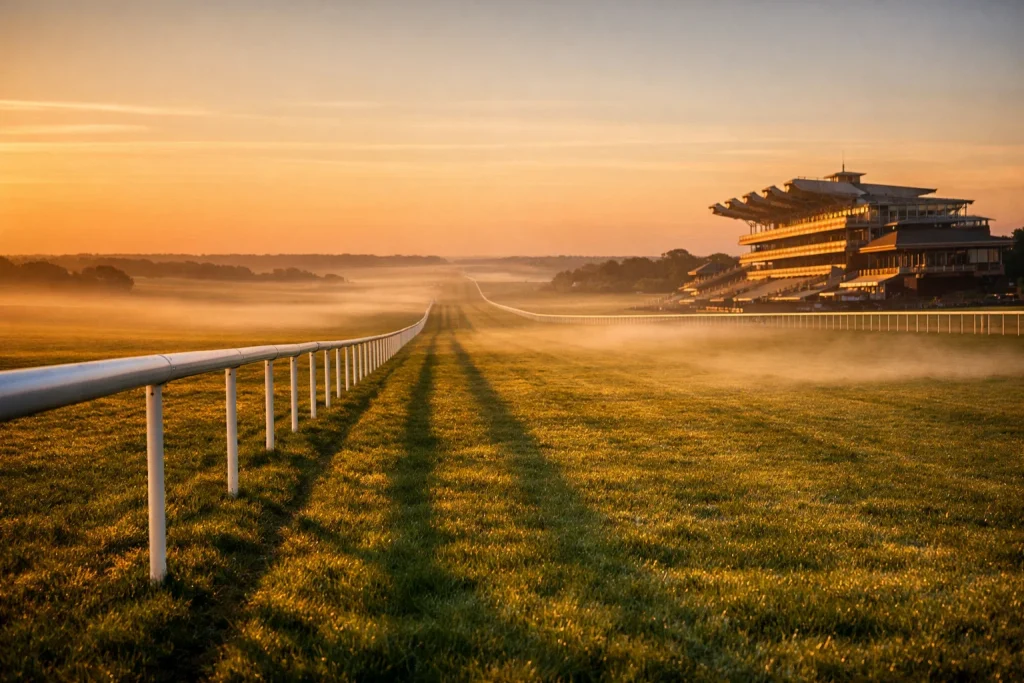
The race was named for its original entry fee: one thousand guineas, a substantial sum in Regency England that ensured only serious contenders would participate. From the beginning, it occupied its current home on the Rowley Mile at Newmarket, the headquarters of British racing and the course that most purely tests speed and stamina without the complications of tight turns or undulating terrain. The straight mile, with its gradual undulations and the famous Dip two furlongs from home, has remained essentially unchanged for over two centuries.
Early runnings of the race attracted small fields by modern standards—sometimes fewer than half a dozen fillies. Prize money was modest, and media coverage nonexistent in any recognisable form. Yet the race quickly established its prestige. Winning the 1000 Guineas marked a filly as exceptional, and breeders noted that the best winners often went on to excel at stud. The commercial logic that drives modern racing was already taking shape, even if the sums involved would seem quaint by current measures.
The Victorian era brought professionalisation. Trainers became specialists, jockeys became celebrities, and betting became organised through the Tote and then the bookmaking industry. The 1000 Guineas attracted larger fields and greater prize funds. By the turn of the twentieth century, it had cemented its place as one of the five British Classics—a designation that carried immense prestige and, increasingly, significant financial reward.
The twentieth century transformed the race’s global significance. Air travel made international participation practical, and bloodstock became a worldwide trade. Irish trainers, who had always competed at Newmarket, became dominant forces. American and Middle Eastern owners invested fortunes in British racing, chasing Classic glory with resources that would have astonished the Regency founders. The 1000 Guineas purse grew accordingly, from hundreds of pounds to hundreds of thousands.
Today, the race sits within an industry whose scale would be unrecognisable to its founders. According to the House of Commons Library, British racing contributes £4.1 billion to the UK economy and supports approximately 85,000 jobs. The 1000 Guineas, as one of the five Classics, anchors the spring programme that attracts global attention and global money. Sponsorship deals, broadcasting rights, and international simulcasting have added revenue streams that did not exist a generation ago.
Yet for all the change, the race’s essential character remains. It is still run over a mile on the Rowley Mile in early May. It still tests the same qualities—speed, stamina, composure under pressure—that it tested in 1814. The fillies who win it still join a lineage that stretches back through generations, their names added to a roll of honour that began when Britain was still a pre-industrial society. Evolution has not erased continuity. The 1000 Guineas is simultaneously a modern global event and an inheritance from a very different world.
The Fillies’ Triple Crown: Seven Who Conquered All Three
The Fillies’ Triple Crown demands three victories across the Classic season: the 1000 Guineas in May, the Oaks at Epsom in June, and the St Leger at Doncaster in September. It tests speed, stamina, and resilience across three different tracks and increasing distances. Completing it requires a filly to remain sound, in form, and superior to her rivals from spring through autumn. In over two hundred years of British flat racing, only seven have managed it.
Hannah achieved the feat first, in 1871. Trained by Joseph Dawson at Newmarket, she swept through the spring and summer unbeaten, winning the 1000 Guineas by a length, the Oaks by a neck, and the St Leger by two lengths. Her campaign established the template: close margins that testified to genuine competition, not walkovers against weak opposition. The Fillies’ Triple Crown, even at its first accomplishment, was clearly something earned rather than given.
Apology followed three years later, in 1874. Her victories were more emphatic—she won the Oaks by half a length, the 1000 Guineas by three lengths, and the St Leger by a head—but she too faced genuine rivals at each stage. The emerging pattern suggested that the feat required not merely talent but the rarest combination of ability and durability. Eighteen years would pass before another filly matched it.
La Fleche, in 1892, brought the Triple Crown into what might be called the modern era of racing. Owned by Baron Hirsch and trained by John Porter at Kingsclere, she was one of the outstanding racehorses of the Victorian age, competing successfully against colts as well as fillies. Her Triple Crown campaign was part of a longer career that included victories in the Ascot Gold Cup and other prestigious races. She demonstrated that the best fillies could transcend their divisions.
Pretty Polly, in 1904, may remain the most celebrated of all. Owned by Eustace Loder and trained by Peter Purcell Gilpin, she won twenty-two of her twenty-four career starts and was considered by many contemporaries to be the greatest racehorse of her generation, male or female. Her Triple Crown was one chapter in a career that also included the Coronation Cup, the Champion Stakes, and numerous other victories. More than a century later, Pretty Polly’s name still evokes an era of racing excellence.
The twentieth century produced three more Triple Crown winners. Sun Chariot, in 1942, achieved the feat during the Second World War, when racing continued on a reduced scale as a morale-boosting exercise. Owned by King George VI and trained by Fred Darling, she won despite the wartime disruptions that affected training schedules and travel. Her victories demonstrated that greatness could emerge even in straitened circumstances.
Meld, in 1955, completed the Triple Crown for trainer Cecil Boyd-Rochfort and owner Lady Zia Wernher. Her campaign was notable for its authority—she won the 1000 Guineas by a length, the Oaks by six lengths, and the St Leger by three lengths. The margins suggested a filly operating at a level above her contemporaries, a dominance that has proved difficult to replicate.
Oh So Sharp, in 1985, remains the most recent Fillies’ Triple Crown winner. Trained by Henry Cecil and ridden by Steve Cauthen, she completed the sweep in an era when racing had begun to assume its modern commercial character. Her victories attracted significant media attention and cemented her place in racing history. Four decades have passed without another Triple Crown, a gap that underscores the feat’s difficulty.
According to How They Run, 49 fillies have achieved the 1000 Guineas and Oaks double—the first two legs of the Triple Crown. Of those, only seven went on to complete the full sweep by adding the St Leger. The dropout rate speaks to the challenge. By September, many fillies are tired, injured, or retired to stud. Those who remain must travel to Doncaster and compete over a mile and three-quarters, a distance that tests even the stoutest stayer. The Fillies’ Triple Crown is not merely rare. It may be the most difficult achievement in British flat racing.
Record Winners, Record Prices: The Extremes of the 1000 Guineas
The 1000 Guineas has produced winners at every point on the odds spectrum, from prohibitive favourites to rank outsiders whose victories reshaped understanding of what is possible in a Classic. These extremes illuminate the race’s character: predictable enough to attract heavy betting, unpredictable enough to produce shocks that punters remember for decades.
At one end of the scale sit the fillies who transcended their sex. Only four have won both the 1000 Guineas and the 2000 Guineas, taking on colts at the highest level and prevailing. Crucifix achieved the double in 1840, followed by Formosa in 1868, Pilgrimage in 1878, and Sceptre in 1902. These fillies were not merely the best of their generation among fillies; they were the best of their generation, period. The rarity of the double—no filly has achieved it in over 120 years—suggests how exceptional they were.
Sceptre deserves particular mention. In 1902, she won the 2000 Guineas, the 1000 Guineas, the Oaks, and the St Leger—four of the five Classics in a single season, failing only in the Derby where she finished fourth behind Ard Patrick. Her campaign remains one of the most remarkable in racing history, a sustained demonstration of brilliance across distances and against the best of both sexes.
At the other extreme sit the long-shot winners, the fillies whose victories sent bookmakers scrambling for their ledgers. Billesdon Brook, in 2018, returned at 66/1—the longest-priced winner in the race’s modern history. Trained by Richard Hannon and ridden by Sean Levey, she came from off the pace to catch the fancied opposition in the final furlong. The result produced headlines, substantial payouts for contrarian punters, and a reminder that Classic fields rarely lack a live outsider.
Other surprise winners have punctuated the record book. Wince, in 1999, won at 25/1 despite starting as an apparent afterthought in her own stable’s challenge. Sayyedati, in 1993, returned at 20/1 after a quiet trial run led the market to dismiss her chances. These results are not aberrations. The 1000 Guineas, for all its prestige, consistently produces outcomes that confound market expectations.
The shortest-priced winners demonstrate that favourites can justify support when the market reads the form correctly. Minding, in 2016, won at 11/10 after dominating her two-year-old season. Winter, in 2017, started at 4/6 and won with professional authority. Desert Flower, in 2026, landed at even money after a juvenile campaign that left connections and punters alike confident of her Classic credentials.
Trainer Ollie Sangster, whose fillies Flight and Simmering finished second and third behind Desert Flower, captured the atmosphere around a short-priced favourite: “We thought she was kind of unbeatable.” When favourites inspire that level of pre-race conviction, the market contracts around them, leaving little room for alternatives. Yet as the statistics confirm, such certainty proves misplaced more often than not. The favourite’s win rate of 38.5% across the race’s history means that, more often than not, the unbeatable proves beatable.
Record times provide another axis of extremes. Ghanaati, in 2009, recorded the fastest 1000 Guineas in history—1:34.22 on good-to-firm ground. At the other end, Speciosa won in 1:40.53 in 2006, a time that reflects the slower going prevalent that year. The six-second gap between fastest and slowest winning times—roughly thirty lengths at racing pace—demonstrates how much ground conditions affect performance. Winners adapt to conditions. The race tests versatility as much as raw speed.
Trainer Dynasties: O’Brien, Cecil, and the Godolphin Machine
Certain trainers have shaped the 1000 Guineas across generations, building records that set benchmarks for everyone who follows. Their dominance reflects not merely individual talent but entire systems: the breeding connections, owner relationships, and stable cultures that channel the best fillies toward Newmarket in May.
Sir Henry Cecil stands as the defining figure of the late twentieth century. Operating from Warren Place at Newmarket, Cecil won the 1000 Guineas six times between 1981 and 2011. His winners included Oh So Sharp, the last Fillies’ Triple Crown winner, and Bosra Sham, who went on to beat colts in the Prince of Wales’s Stakes at Royal Ascot. Cecil’s training style emphasised patience and sympathy with each horse’s temperament—qualities particularly suited to handling talented but sometimes temperamental fillies.
Cecil’s great rival in Classic races was Michael Stoute, who won the 1000 Guineas four times. Stoute’s approach differed: more methodical, more rooted in the patterns of training that produce consistent improvement rather than spectacular leaps. His winners included Sayyedati and Shadayid, both of whom arrived at Newmarket with solid credentials and delivered on expectation. The Cecil-Stoute rivalry animated British flat racing for decades, with the 1000 Guineas among their regular battlegrounds.
Aidan O’Brien has reshaped expectations in the twenty-first century. Training at Ballydoyle for the Coolmore partners, O’Brien has won the 1000 Guineas seven times, surpassing Cecil’s total. His winners include Minding, Winter, Hermosa, and Tuesday—fillies who combined speed with the ability to handle Newmarket’s unique demands. O’Brien’s system produces runners for multiple Classics each year, and his ability to target races with the right horse at the right moment has made Ballydoyle the dominant force in British and Irish Classic racing.
Godolphin, the racing operation founded by the Maktoum family of Dubai, has added another dimension to the trainer landscape. Charlie Appleby, training at Moulton Paddocks in Newmarket, won the 2026 1000 Guineas with Desert Flower, continuing Godolphin’s pursuit of Classic success with deep resources and patient development of promising fillies. Godolphin’s approach relies on scale: their breeding programmes produce large numbers of potential Classic horses, and the best are funnelled toward the spring targets.
The concentration of success among a small number of operations reflects broader economic realities. According to the BHA 2026 Racing Report, British racing’s total prize money reached a record £194.7 million in 2026, with the Levy Board, racecourses, and owner contributions all increasing. The 1000 Guineas, with its guaranteed purse exceeding half a million pounds, attracts the best-resourced stables because the reward justifies the investment. Trainers without similar backing can occasionally compete—Richard Hannon’s Billesdon Brook proved as much—but the structural advantages favour those with depth.
Yet records are made to be challenged. Each generation produces new trainers who learn from predecessors and bring fresh approaches. William Haggas, Ralph Beckett, and Andrew Balding have all won Classics in recent years, disrupting the Ballydoyle-Godolphin duopoly. The history of the 1000 Guineas suggests that dominance is temporary. Cecil replaced earlier dynasties; O’Brien supplanted Cecil; someone will eventually supplant O’Brien. The race endures; the names on the trophy change.
Modern Era: What the Last Decade Tells Us
The last decade of the 1000 Guineas has produced patterns that shape how punters approach the race today. Field sizes have fluctuated, favourites have underperformed historical norms, and the emergence of international raiders has added complexity to a race that already demanded careful analysis. Understanding this recent history provides context for future betting decisions.
Favourite performance stands out as the most striking pattern. Since 2013, only two market favourites have won the 1000 Guineas: Minding in 2016 and Desert Flower in 2026. The intervening years produced a string of upsets. Legatissimo landed at 9/1 in 2015. Billesdon Brook, as noted, returned at 66/1 in 2018. Hermosa won at 6/1 in 2019 despite representing the Ballydoyle yard that should have attracted shorter prices. The market has repeatedly overvalued leading fancies, creating opportunities for punters willing to look beyond the obvious.
Desert Flower’s 2026 victory arrived with significant historical weight. Trained by Charlie Appleby and ridden by William Buick, she became the first unbeaten winner of the 1000 Guineas since Attraction in 2004—a gap of over two decades. Her juvenile campaign included victories in the Albany Stakes and the Fillies’ Mile, each performance reinforcing the impression that here was a filly of genuine Classic calibre. When she delivered at Newmarket, she validated a confidence that had been building for nearly a year.
The emergence of Godolphin as a dominant Classic force represents a shift in power. For years, Ballydoyle monopolised the narrative, with O’Brien’s multiple runners attracting most of the market attention. Desert Flower’s victory demonstrated that Appleby’s operation could compete at the highest level, matching Ballydoyle’s depth with Newmarket’s home advantage. The balance of Classic power may be tilting, or Desert Flower may prove an outlier. Future seasons will clarify which interpretation is correct.
International participation has increased, though the race remains predominantly a contest between British and Irish fillies. French-trained challengers occasionally compete, and American owners invest heavily through British trainers. The globalisation of bloodstock means that pedigrees span continents: Desert Flower is by Night Of Thunder out of Land Of Dreams, combining Irish and British bloodlines through a sire who stood in England but traced to Dubawi’s international breeding operation. The 1000 Guineas is a British Classic, but the forces that produce its winners are genuinely international.
Prize money has grown significantly over the decade, reflecting both sponsorship investment and the Levy Board’s record contributions. The guaranteed purse now exceeds £500,000, with the winner taking over £300,000. These sums justify the expense of Classic preparation—the patient development of promising two-year-olds, the targeted trial campaigns, the careful management of a filly’s physical and mental wellbeing through the stress of top-level competition. Economics shape entries: only fillies with genuine Classic potential warrant the investment required to compete.
Looking forward, the patterns of the last decade suggest several betting principles. First, respect the favourite but do not assume she will win—the strike rate is too low to justify short prices reflexively. Second, look for fillies with proven Newmarket form, particularly those who contested the Fillies’ Mile. Third, monitor Godolphin and Ballydoyle entries carefully, but do not ignore challengers from other operations who may offer value. Fourth, remember that the race produces surprises with regularity. History provides guidance, not certainty. The next chapter of the 1000 Guineas story remains unwritten.